8 USPack Alternatives for Businesses to Use in 2026
USPack is a known final-mile logistics provider for businesses that need same-day, routed, healthcare, retail, ecommerce, auto parts, big-and-bulky, and white-glove delivery support. But teams searching for USPack alternatives are usually evaluating something more specific than another courier name.
They are asking which delivery partner can support their workflow with the right mix of coverage, visibility, proof of delivery, industry experience, courier standards, integrations, and support.
That question matters because final-mile delivery affects more than transportation. It can shape customer experience, inventory availability, pharmacy handoffs, specimen movement, retail delivery promises, route performance, and exception resolution.
The pressure is especially clear in retail and ecommerce. According to the U.S. Census Bureau, U.S. retail ecommerce sales reached $326.7 billion in Q1 2026, accounting for 16.9% of total retail sales. As more orders move through ecommerce, store fulfillment, pharmacy delivery, healthcare logistics, and enterprise distribution networks, final-mile performance becomes a business-critical decision.
This guide compares the top USPack alternatives by use case, strengths, limitations, and operational fit so logistics, operations, and procurement teams can build a practical shortlist based on how deliveries actually move.
What Does USPack Do?
USPack describes itself as a same-day and final-mile logistics provider for retail, medical, pharma, auto parts, big-and-bulky, healthcare, and white-glove delivery. Its listed final-mile capabilities include on-demand courier delivery, routed delivery, retail pool distribution, delivery from store, cross-dock operations, and white-glove delivery.
That makes USPack a broad final-mile provider rather than a narrow courier service. Businesses comparing alternatives should evaluate potential partners against the same delivery categories:
- Same-day and on-demand delivery
- Routed and scheduled delivery
- Retail and ecommerce delivery
- Healthcare, medical, and pharmacy delivery
- Auto parts and field operations delivery
- Big-and-bulky or white-glove delivery
- Cross-dock or distribution support
- Tracking, reporting, and delivery visibility
The best USPack alternative will depend on where your current delivery operation needs more control. For one business, that may mean better proof of delivery. For another, it may mean healthcare-specific workflows, recurring routes, stronger support, or more reliable same-day capacity in key markets.
Why USPack Alternatives Are Not One-to-One Replacements
USPack covers several final-mile use cases, which means the right alternative depends on the part of the operation a business needs to improve.
A healthcare team may care most about chain-of-custody documentation, recipient verification, BAA requirements, and audit-ready delivery records. A retailer may prioritize delivery-from-store execution, customer tracking, delivery windows, and returns support. An auto parts distributor may need route density, early-morning delivery reliability, and local market coverage. An enterprise logistics team may need API connectivity, dashboards, SLA reporting, and multi-market consistency.
That is why this list includes several types of providers:
- Courier partners for direct delivery execution and service accountability
- Healthcare courier specialists for medical, pharmacy, lab, and clinical workflows
- Delivery marketplaces for flexible local coverage and added capacity
- Delivery orchestration platforms for coordinating multiple providers
- Enterprise logistics providers for broader transportation and supply chain programs
The best USPack alternative is the provider whose model matches the delivery problem your team is trying to solve.
How to Evaluate USPack Alternatives

A useful shortlist should separate true operational fit from surface-level similarity. Two providers may both offer final-mile delivery, but their models can differ significantly. Some are courier partners. Some are gig networks. Some are orchestration platforms. Others are enterprise logistics providers with broad transportation services.
Use the criteria below to compare USPack alternatives more clearly.
Delivery Model and Service Fit
Start with the delivery type your business actually needs. A retailer with occasional urgent orders may prioritize on-demand delivery, while a pharmacy, lab, auto parts distributor, or enterprise operation may need recurring scheduled delivery or route-based service.
Key delivery models to compare include:
- Same-day delivery
- Scheduled delivery
- Routed delivery
- Express delivery
- STAT delivery
- Delivery from store
- White-glove or big-and-bulky delivery
- Reverse logistics or returns support
The closer the provider’s service model matches your operational rhythm, the easier implementation and performance management become.
Industry Fit
Industry experience matters because delivery risk changes by vertical. Retail deliveries often depend on customer communication and delivery windows. Healthcare logistics may require HIPAA-aware workflows, chain-of-custody documentation, secure handoffs, and proof of delivery. Auto parts delivery may depend on route density, delivery timing, and local market coverage.
For companies moving medical supplies, prescriptions, lab specimens, or other sensitive healthcare items, a provider with clear healthcare logistics experience should be evaluated differently from a general local delivery marketplace.
Tracking, Proof of Delivery, and Visibility
Visibility is one of the clearest ways to compare USPack competitors. Real-time tracking, ETA updates, delivery dashboards, exception alerts, and handoff documentation help teams manage what happens after dispatch.
Strong last-mile delivery tracking should support both internal operations and customer-facing communication. Strong proof of delivery should document the handoff through the right combination of signature capture, timestamps, recipient verification, photos where appropriate, and digital confirmation.
For high-value, regulated, or time-sensitive deliveries, the question is simple: can your team prove what happened, when it happened, and who received the delivery?
Integrations, Reporting, and Operational Control
Enterprise teams should also evaluate how each provider fits into existing systems. Depending on the operation, that may include order management systems, TMS, WMS, OMS, ecommerce platforms, pharmacy systems, or internal reporting workflows.
Ask whether the provider supports:
- API integrations
- Dashboard access
- Delivery status reporting
- Exception reporting
- Route performance data
- Customer communication tools
- Custom workflow requirements
The goal is to reduce manual work and give operations teams a clearer view of delivery performance.
Support, SLAs, and Accountability
Delivery issues happen. The differentiator is how quickly the provider identifies, communicates, and resolves them.
In 2025, Pitney Bowes reported that U.S. parcel volume reached 23.1 billion shipments in 2025, up 3.3% year over year. As parcel and final-mile networks continue to grow, businesses need delivery partners that can manage volume, exceptions, and support with consistency.
Evaluate each provider’s:
- Support availability
- Escalation process
- SLA structure
- Courier standards
- Training expectations
- Background check policies
- Exception management process
- Reporting cadence
This is where last-mile logistics risk management becomes a practical buying lens. A lower-cost provider may become expensive if delivery issues create missed appointments, failed handoffs, compliance exposure, inventory disruption, or customer churn.
Comparison Table: Top USPack Alternatives
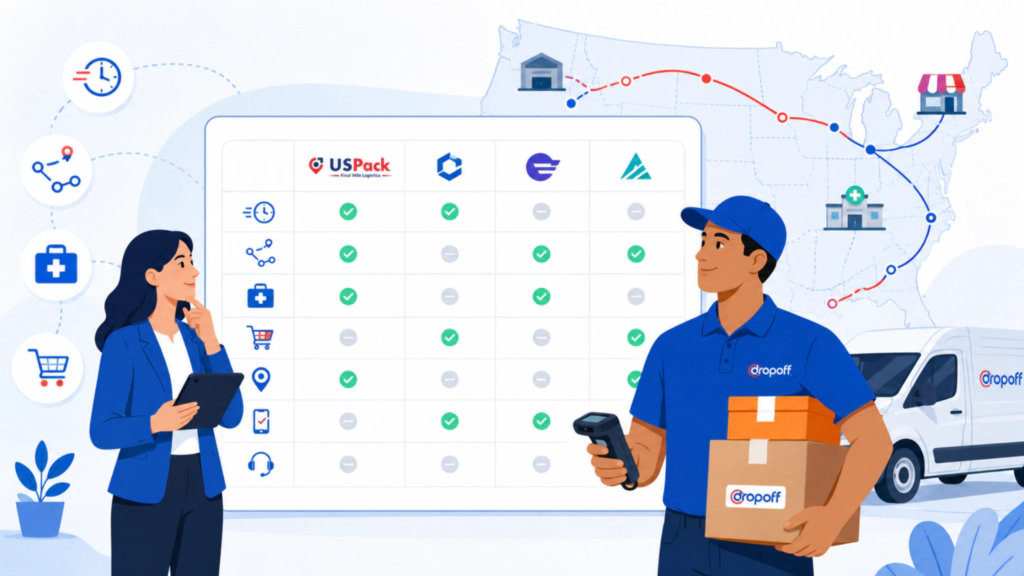
Use this table as a first-pass shortlist, not a final vendor decision. Public capabilities can vary by market, service tier, contract, integration setup, and workflow. For regulated, high-value, recurring, or customer-facing deliveries, confirm proof of delivery, exception handling, courier standards, reporting, and support before selecting a provider.
The key question is not simply “Can this provider deliver?” It is “Can this provider support the way our operation needs delivery to work?”
| Company | Best For | Same-Day Delivery | Healthcare Capable | Retail / Ecommerce Fit | Tracking + POD | API / Integrations | Potential Limitation |
| Dropoff | B2B same-day, scheduled, and healthcare-aware delivery | Yes | Yes | Yes | Yes | Confirm by workflow | Best fit for businesses needing service accountability and customized delivery programs |
| Roadie | Broad local same-day coverage | Yes | Limited / verify | Yes | Varies by service | Verify | Network-based model may require extra review for regulated or tightly controlled workflows |
| OneRail | Enterprise delivery orchestration | Yes | Verify | Yes | Yes | Yes | More orchestration-focused than direct courier partner |
| MedSpeed | Healthcare systems, labs, and clinical logistics | Yes / verify | Yes | Limited | Verify | Verify | Healthcare-specific fit may be less relevant for retail or general business delivery |
| SDS Rx | Pharmacy and healthcare delivery | Yes / verify | Yes | Limited | Verify | Verify | Best aligned to pharmacy and healthcare use cases |
| American Expediting | Time-sensitive medical and business courier needs | Yes | Yes / verify | Some | Yes / verify | Verify | Coverage and service depth should be confirmed by market |
| Courier Express | Regional courier and final-mile delivery | Yes / verify | Verify | Yes / verify | Verify | Verify | Regional strength may vary for multi-market programs |
| GEODIS / Need It Now Delivers | Enterprise logistics and final-mile support | Yes / verify | Verify | Yes | Verify | Verify | Broader enterprise model may be more complex than a dedicated courier solution |
Best-Fit Matrix: Which Type of Provider Should You Compare?
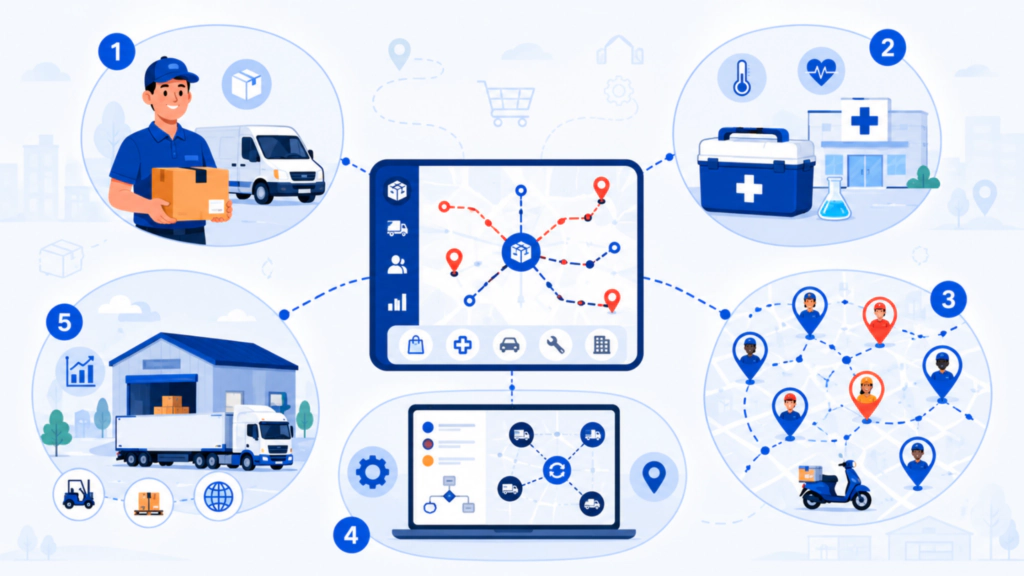
A USPack alternative should be evaluated by provider type, not just company name. Use this matrix to narrow the shortlist before reviewing individual vendors.
| Business Need | Provider Type to Compare | Best-Fit Providers From This List |
| Same-day B2B delivery with direct service accountability | Courier partner | Dropoff |
| Recurring routes, scheduled delivery, or planned delivery programs | Courier partner or regional courier | Dropoff, Courier Express |
| Healthcare, pharmacy, lab, or clinical delivery | Healthcare courier or healthcare-aware courier partner | Dropoff, MedSpeed, SDS Rx |
| Broad local delivery coverage or overflow capacity | Delivery marketplace | Roadie |
| Multi-provider delivery coordination and routing logic | Delivery orchestration platform | OneRail |
| Retail or ecommerce final-mile delivery | Courier partner, delivery marketplace, or orchestration platform | Dropoff, Roadie, OneRail, GEODIS / Need It Now Delivers |
| Enterprise logistics tied to warehousing or transportation management | Enterprise logistics provider | GEODIS / Need It Now Delivers |
| Auto parts or field operations delivery | Courier partner, delivery marketplace, or regional courier | Dropoff, Roadie, Courier Express |
The strongest shortlist may include more than one provider type. For example, a retailer may compare a courier partner for controlled same-day delivery, a delivery marketplace for overflow, and an orchestration platform if it needs to coordinate several carriers through one system.
8 Best USPack Alternatives for Businesses
1. Dropoff
Dropoff is a same-day and last-mile logistics provider serving businesses across healthcare, retail, ecommerce, industrial, and enterprise operations.
Best for: Businesses that need accountable same-day, scheduled, and route-based delivery with real-time tracking, digital confirmations, professional courier standards, and workflows built around business requirements.
Dropoff is a strong USPack alternative for teams that need more control over the final mile. Its delivery programs support urgent on-demand delivery, recurring scheduled delivery, route-based service, and customized logistics workflows.
That makes Dropoff a practical fit for several operational scenarios:
- A pharmacy needs same-day delivery with recipient verification and digital confirmation.
- A healthcare organization needs delivery visibility for time-sensitive supplies or lab-related workflows.
- A retailer needs local delivery support with tracking and proof of delivery.
- An enterprise team needs a delivery partner that can support recurring routes, exceptions, and reporting across key markets.
- A field operations team needs reliable same-day movement of parts, equipment, or business-critical items.
Key differentiators vs. USPack: Dropoff emphasizes business-focused delivery programs with real-time tracking, digital confirmations, professional couriers, operational support, and flexible delivery workflows. It is especially relevant for teams that want a provider focused on visibility, handoff verification, service accountability, and industry-specific delivery requirements.
Potential limitations: Businesses with highly specialized big-and-bulky, white-glove, freight, or cross-dock requirements should confirm fit by market, shipment profile, and service model.
Best-fit industries: Healthcare, pharmacy, retail, ecommerce, industrial, enterprise operations, and business services.
2. Roadie
Roadie is a UPS company offering local same-day delivery through a large network of independent drivers. Roadie is often used for retail, ecommerce, auto parts, oversized items, and local delivery programs.
Best for: Businesses that need broad local same-day coverage and flexible capacity.
Roadie publicly describes its network as including 310,000+ independent drivers and access to 97% of U.S. households. Its ship-from-store materials also reference delivery to 30,000+ zip codes. That reach can be useful for retailers or shippers that need flexible local delivery coverage across many markets.
Key differentiators vs. USPack: Roadie may be a good fit for businesses prioritizing broad local delivery capacity, especially for retail, ecommerce, auto parts, and oversized delivery use cases.
Potential limitations: Roadie is a network-based delivery platform. Businesses with highly controlled healthcare, chain-of-custody, pharmacy, or recurring route requirements should verify courier standards, compliance fit, support model, proof of delivery options, and exception workflows before choosing it as a USPack alternative.
Best-fit industries: Retail, ecommerce, auto parts, local delivery, oversized delivery.
3. OneRail
OneRail is a last-mile delivery orchestration platform that connects enterprise shippers with delivery networks and provides visibility across orders.
Best for: Enterprise shippers that need to coordinate multiple delivery providers through one platform.
OneRail is different from a traditional courier company. Its value is in orchestration: connecting shippers to carrier capacity, automating delivery decisions, and providing visibility across last-mile execution. OneRail says its last-mile delivery software connects enterprise shippers to 12M+ drivers and provides real-time visibility across every order.
Key differentiators vs. USPack: OneRail may fit businesses that already work with multiple delivery providers and need a platform to manage fulfillment logic, delivery visibility, and routing decisions.
Potential limitations: A company looking for a dedicated courier partner may need a different model. OneRail is best evaluated as delivery orchestration rather than a one-to-one replacement for a courier provider.
Best-fit industries: Retail, ecommerce, enterprise fulfillment, omnichannel operations, multi-carrier delivery programs.
4. MedSpeed
MedSpeed is a healthcare logistics provider focused on health systems, laboratories, pharmacies, and clinical networks.
Best for: Healthcare organizations, hospitals, labs, and clinical logistics operations.
MedSpeed is a relevant USPack alternative for healthcare teams that need medical courier expertise and system-wide logistics support. The company says it helps healthcare organizations move specimens, pharmaceuticals, supplies, and other physical materials across the last mile. It is strongest when the delivery network is primarily inside a health-system, lab, pharmacy, or clinical environment rather than a broad retail or ecommerce operation.
Key differentiators vs. USPack: MedSpeed’s strength is its healthcare focus. It may be a strong fit for health systems and labs looking for a courier provider that understands clinical logistics, specimen movement, healthcare network design, and medical courier operations.
Potential limitations: Businesses outside healthcare may find MedSpeed’s specialization less aligned with retail, ecommerce, auto parts, or general enterprise delivery needs.
Best-fit industries: Health systems, laboratories, pharmacies, clinical networks, healthcare supply chain.
When to shortlist MedSpeed: Shortlist MedSpeed when the delivery network is primarily healthcare-specific, especially if the operation involves health systems, labs, pharmacies, specimens, pharmaceuticals, or clinical supply movement.
5. SDS Rx
SDS Rx is a healthcare delivery and logistics provider focused on pharmacies, laboratories, and healthcare systems.
Best for: Pharmacy delivery, long-term care pharmacy, healthcare delivery, and medication logistics.
SDS Rx is most relevant for companies evaluating USPack alternatives in pharmacy or healthcare settings. Its materials position the company around healthcare delivery logistics, pharmacy delivery, and a nationwide healthcare delivery network. It is strongest when medication delivery, long-term care pharmacy, laboratory logistics, or healthcare-specific delivery workflows are the central requirement.
Key differentiators vs. USPack: SDS Rx may be a strong fit for pharmacy networks, long-term care pharmacy providers, specialty pharmacy operations, and healthcare teams that need a partner focused specifically on medical and pharmaceutical delivery.
Potential limitations: Businesses with broader retail, ecommerce, auto parts, or general final-mile needs should verify whether SDS Rx aligns with their delivery model and coverage requirements.
Best-fit industries: Pharmacy, long-term care, healthcare, laboratories, pharmaceutical logistics.
When to shortlist SDS Rx: Shortlist SDS Rx when medication delivery, long-term care pharmacy, pharmacy network support, or healthcare delivery logistics are the primary requirements.
6. American Expediting
American Expediting has historically served time-sensitive delivery needs, including medical courier, routed delivery, and on-demand logistics.
Best for: Medical courier needs, routed delivery, urgent business delivery, and time-sensitive shipments.
American Expediting’s routed delivery materials describe services built around optimized routes, trained drivers, real-time tracking, and full visibility. That makes it relevant to the USPack competitor set if the business is evaluating routed delivery, urgent medical courier needs, or time-sensitive business shipments.
Key differentiators vs. USPack: American Expediting may be a fit for businesses with urgent shipments, healthcare logistics requirements, or recurring delivery routes that need trained courier support.
Potential limitations: Before including American Expediting in a 2026 shortlist, verify current service status, coverage, and continuity. Public information about courier networks can change, and businesses should confirm whether the provider is actively serving their required markets and delivery types.
Best-fit industries: Healthcare, life sciences, business courier, time-sensitive delivery, critical inventory.
7. Courier Express
Courier Express is a regional courier and final-mile provider serving business delivery needs across select markets.
Best for: Regional courier coverage, local delivery programs, and final-mile support where its footprint aligns with the customer’s operation.
Courier Express may be a useful USPack alternative for businesses that prioritize regional strength over broad national standardization. Its site emphasizes time-sensitive same-day delivery and courier delivery services. Regional courier providers can be valuable when route density, local knowledge, dispatch responsiveness, and market-level service consistency matter more than a broad national footprint.
Key differentiators vs. USPack: Courier Express may work well for companies with concentrated regional delivery needs, especially where its network and service offering match pickup and delivery locations.
Potential limitations: Businesses with multi-market or national delivery programs should verify coverage consistency, reporting, support structure, and service standards across all required locations.
Best-fit industries: Retail, business courier, regional logistics, final-mile delivery.
When to shortlist Courier Express: Shortlist Courier Express when regional density, local dispatch knowledge, and same-day courier responsiveness matter more than a standardized national delivery program.
8. GEODIS / Need It Now Delivers
Need It Now Delivers is now part of GEODIS, a global transport and logistics provider. GEODIS announced that the acquisition of Need It Now Delivers expanded its U.S. presence in contract logistics and final-mile delivery.
Best for: Larger enterprise logistics programs, final-mile support, omnichannel logistics, and businesses needing broader transportation infrastructure.
For companies evaluating USPack alternatives at enterprise scale, GEODIS / Need It Now Delivers may be worth considering. It can be relevant for businesses that need more than courier service, including contract logistics, final-mile delivery, transportation management, warehousing, and broader supply chain capabilities.
Key differentiators vs. USPack: GEODIS brings a larger logistics infrastructure and may fit businesses that want final-mile delivery connected to broader logistics operations.
Potential limitations: Businesses looking for a straightforward same-day courier partner may find a large enterprise logistics model more complex than needed. Implementation scope, pricing, service structure, and support model should be reviewed carefully.
Best-fit industries: Enterprise logistics, ecommerce, omnichannel retail, distribution, transportation management.
When to shortlist GEODIS / Need It Now Delivers: Shortlist GEODIS / Need It Now when final-mile delivery needs to connect with broader logistics infrastructure, such as warehousing, transportation management, omnichannel fulfillment, or enterprise distribution.
How to Read This Shortlist
The strongest provider depends on the delivery problem behind the search.
- Choose a courier partner when the business needs direct service accountability, professional courier standards, and delivery workflows matched to daily operations.
- Choose a healthcare courier specialist when the business needs medical courier experience, pharmacy delivery support, chain-of-custody workflows, or healthcare-specific documentation.
- Choose a delivery marketplace when the business needs flexible local coverage and added delivery capacity, especially for retail, ecommerce, auto parts, or oversized local delivery.
- Choose a delivery orchestration platform when the business already works with multiple providers and needs a system to coordinate routing logic, visibility, and carrier selection.
- Choose an enterprise logistics provider when final-mile delivery needs to connect with broader warehousing, transportation, or supply chain programs.
For many B2B teams, the best shortlist includes one execution-focused delivery partner and one or two specialized options for specific markets, verticals, or overflow needs.
Common Reasons Businesses Evaluate USPack Alternatives
Businesses usually compare USPack alternatives when their delivery requirements have changed or when the current final-mile model is creating operational friction.
Common triggers include:
- Limited visibility into pickup, transit, delivery status, or exceptions
- Need for stronger proof of delivery or recipient verification
- Missed delivery windows or inconsistent route performance
- Market coverage gaps in priority pickup or delivery areas
- Healthcare, pharmacy, lab, or chain-of-custody requirements
- Retail or ecommerce delivery experience issues
- Need for more responsive support or clearer escalation paths
- Poor exception documentation after failed handoffs
- Limited dashboard, reporting, or integration capabilities
- Growing volume that requires a more structured same-day or scheduled delivery program
These triggers should guide the shortlist. A business struggling with route reliability may need a different provider than one struggling with healthcare documentation, retail customer communication, or multi-provider orchestration.
Which USPack Alternative Is Best for Your Business?
The best USPack alternative depends on the delivery workflow your team needs to improve. Before choosing a provider, identify the operational problem first: same-day execution, healthcare documentation, retail delivery experience, regional coverage, recurring routes, delivery orchestration, or broader enterprise logistics support.
Use the categories below to narrow the shortlist by delivery model, industry fit, visibility needs, and support expectations.
Best for B2B Same-Day Delivery
Best fit: Dropoff
Dropoff is a strong fit for businesses that need same-day delivery with real-time tracking, digital proof of delivery, professional courier standards, and flexible workflows.
This is the right category for teams moving time-sensitive business items, retail orders, medical supplies, pharmacy deliveries, replacement parts, or urgent operational materials. The buying criteria should include pickup speed, delivery-window performance, handoff documentation, exception support, and market coverage.
Best for Healthcare Logistics
Best fits: Dropoff, MedSpeed, SDS Rx, American Expediting
Healthcare delivery requires stronger verification than standard courier service. Teams moving prescriptions, specimens, supplies, devices, or clinical materials should compare providers based on HIPAA-aware workflows, BAA requirements where applicable, chain-of-custody support, proof of delivery, recipient verification, temperature control needs, and audit-ready reporting.
Dropoff is a strong fit when healthcare delivery is part of a broader same-day or scheduled delivery program. MedSpeed may be stronger for health-system logistics. SDS Rx is more pharmacy-specific. American Expediting may fit time-sensitive medical courier needs.
Best for Retail and Ecommerce Delivery
Best fits: Dropoff, Roadie, OneRail, GEODIS / Need It Now Delivers
Retail and ecommerce teams should evaluate final-mile providers by delivery speed, delivery windows, tracking, customer communication, proof of delivery, returns support, and local coverage. Delivery performance can directly affect buyer trust. DHL reports that 73% of global shoppers won’t buy if they don’t trust the delivery provider.
Returns also add operational pressure. NRF projects that 19.3% of online sales are expected to be returned in 2025, making reverse-logistics visibility and handoff documentation more important for ecommerce teams.
Dropoff is a strong fit for businesses that need ecommerce delivery with same-day support, tracking, and delivery verification. Roadie may fit flexible local delivery coverage. OneRail may fit orchestration. GEODIS / Need It Now may fit larger enterprise logistics programs.
Best for Auto Parts and Field Operations Delivery
Best fits: Dropoff, Roadie, Courier Express, American Expediting
Auto parts and field operations teams often need reliable local delivery, early cutoffs, route consistency, and proof that the right item reached the right location. A missed delivery can delay a repair, stall a technician, or create unnecessary inventory movement.
For this use case, compare providers by local market coverage, dispatch responsiveness, recurring route capability, proof of delivery, and exception handling.
Best for Delivery Orchestration
Best fit: OneRail
OneRail is best for companies managing multiple delivery networks or carriers. It helps enterprise shippers coordinate capacity, routing logic, and visibility through a platform-led model.
This can be valuable when a business wants to manage many delivery partners from one system. For teams that want direct delivery execution and service accountability, a courier partner such as Dropoff may be a better fit.
Best for Regional Courier Coverage
Best fit: Courier Express
Courier Express may be a good option for businesses with regional delivery needs where its footprint aligns with pickup and delivery locations. Regional providers can offer strong local knowledge and market-specific support.
For multi-market operations, teams should verify whether the provider can deliver consistent reporting, support, courier standards, and service performance across all required locations.
What to Verify Before Switching Final-Mile Providers
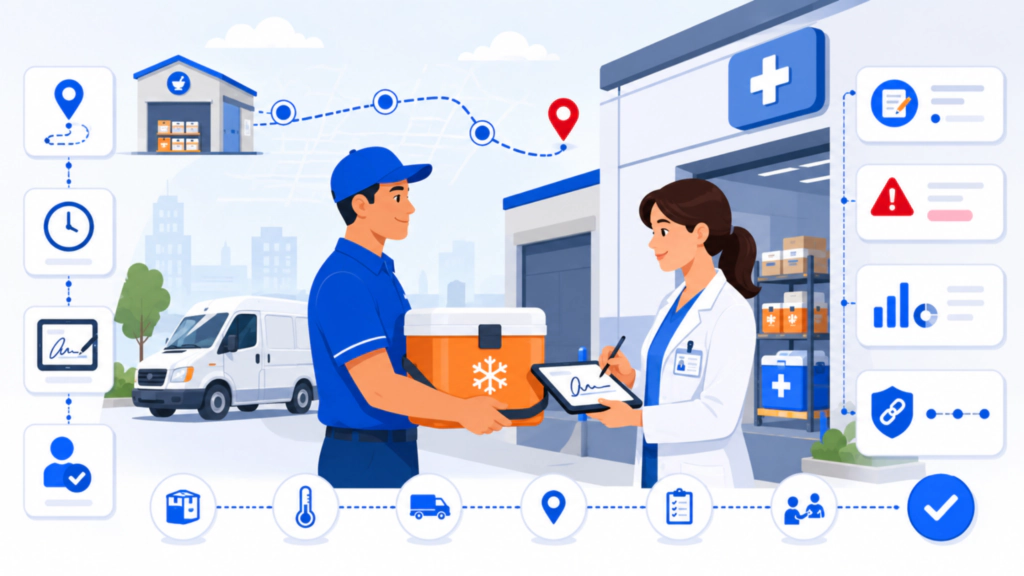
Before switching from USPack or adding another final-mile partner, procurement and operations teams should evaluate how the provider will perform in the real workflow, not just on a capabilities list. Use the checklist below to guide sales conversations, RFPs, and pilot programs
Coverage and Service Model
Confirm whether the provider supports your required pickup and delivery markets, delivery windows, same-day needs, routed delivery programs, scheduled deliveries, express deliveries, STAT requests, and recurring delivery volume.
Ask:
- Which markets are directly supported?
- Which services are available in each market?
- How does coverage change after hours, on weekends, or during peak periods?
- Can the provider support both planned routes and urgent requests?
Visibility and Handoff Documentation
For many businesses, delivery visibility is the difference between a shipment that is “out for delivery” and a shipment the team can actively manage.
Ask:
- Is real-time tracking available?
- Can internal teams access a dashboard?
- What proof of delivery options are available?
- Can proof include signature, timestamp, recipient name, photo, or delivery notes?
- How are failed delivery attempts documented?
- How are exceptions communicated?
Industry and Compliance Fit
Healthcare, pharmacy, lab, and other compliance-sensitive workflows need extra review. HHS explains that covered entities need written assurances that business associates will safeguard protected health information, with contracts defining permitted uses, safeguards, and disclosure limits through business associate safeguards for protected health information.
For specimen movement, the CDC notes that each organization handling specimens is responsible for them while in its control, and receiving organizations must sign off when accepting specimens. That makes specimen chain-of-custody documentation an important evaluation point for clinical and lab logistics.
Ask:
- Are HIPAA-aware workflows available?
- Is a BAA available when PHI may be involved?
- Can the provider support chain-of-custody requirements?
- Can the provider document custody transfer and recipient verification?
- Can temperature-sensitive workflows be supported when needed?
Support, SLAs, and Reporting
The provider’s response to exceptions can matter as much as the delivery itself.
Ask:
- What support channels are available?
- Is support available during the delivery windows your business uses?
- What escalation process is used for missed deliveries, wrong addresses, delays, or failed handoffs?
- What SLA reporting is included?
- Can performance be reviewed by route, market, location, delivery type, or account?
For a broader vendor evaluation framework, review Dropoff’s guide on how to choose a third-party logistics provider.
Why Businesses Choose Dropoff as a USPack Alternative
Dropoff is a credible USPack alternative for businesses that want a final-mile partner focused on visibility, verification, and workflow fit.
For many companies, the final-mile challenge is control. Operations teams need to know when an item was picked up, where it is in transit, who received it, what happened during the handoff, and how exceptions were handled. That matters for customer experience, inventory movement, healthcare logistics, retail operations, pharmacy delivery, and enterprise supply chain performance.
Dropoff is especially relevant when a business needs:
- Same-day delivery for time-sensitive orders
- Scheduled or recurring delivery programs
- Route-based delivery support
- Healthcare-aware logistics workflows
- Retail and ecommerce delivery support
- Real-time tracking and delivery visibility
- Digital proof of delivery and confirmation
- Professional courier standards
- Operational support and issue resolution
- Delivery workflows tailored to business requirements
That makes Dropoff a strong fit for teams that are comparing USPack alternatives because of gaps in visibility, handoff documentation, service responsiveness, recurring route support, or industry-specific delivery requirements.
A logistics team evaluating Dropoff should come prepared with its pickup and delivery markets, average delivery volume, delivery windows, route needs, proof of delivery requirements, integration requirements, and any healthcare, pharmacy, retail, or enterprise workflow needs. Those details make it easier to map the right delivery program.
That conversation should be specific. A stronger vendor evaluation starts with the details that shape the delivery program: pickup locations, delivery zones, delivery windows, same-day volume, recurring route needs, proof-of-delivery requirements, exception patterns, support expectations, and any healthcare, pharmacy, retail, ecommerce, or enterprise workflow requirements.
For businesses comparing USPack alternatives, those inputs help determine whether the right solution is on-demand delivery, scheduled delivery, route-based support, industry-specific logistics, or a blended delivery program.
Comparing USPack alternatives? Talk with Dropoff about your delivery volume, markets, delivery windows, proof-of-delivery needs, and industry requirements. The team can help map the right same-day, scheduled, or route-based delivery program for your operation.
Final Takeaway
USPack alternatives should be compared by operational fit, not name recognition alone. The right provider should match your delivery model, support your industry requirements, document the handoff, give your team visibility, and manage exceptions with clear accountability.
For businesses that need same-day delivery, scheduled routes, real-time tracking, proof of delivery, and business-focused logistics support, Dropoff belongs near the top of the shortlist.
FAQs About USPack Alternatives
The best USPack alternatives include Dropoff, Roadie, OneRail, MedSpeed, SDS Rx, American Expediting, Courier Express, and GEODIS / Need It Now Delivers. The right choice depends on your delivery model, industry, coverage needs, tracking requirements, proof of delivery expectations, compliance needs, and support structure.
USPack competitors vary by use case. Dropoff is a strong B2B same-day and last-mile option. Roadie fits broad local delivery coverage. OneRail fits enterprise delivery orchestration. MedSpeed and SDS Rx are stronger healthcare-specific options. American Expediting, Courier Express, and GEODIS / Need It Now Delivers may also be relevant depending on delivery type and market coverage.
Businesses should compare USPack alternatives by delivery type, market coverage, industry fit, tracking, proof of delivery, integrations, courier standards, exception management, support availability, and SLA structure. Healthcare and pharmacy teams should also review HIPAA-aware workflows, BAA requirements, chain-of-custody documentation, temperature control needs, and audit reporting.
Yes. Dropoff is a strong alternative to USPack for businesses that need same-day delivery, scheduled delivery, real-time tracking, digital proof of delivery, professional courier standards, and flexible delivery workflows. It is especially relevant for healthcare, retail, ecommerce, industrial, and enterprise teams that want stronger visibility into pickup, transit, handoff, exceptions, and delivery confirmation.
The best USPack alternatives for healthcare logistics include Dropoff, MedSpeed, SDS Rx, and American Expediting. Healthcare teams should compare providers based on medical courier experience, HIPAA-aware processes, BAA availability, chain-of-custody support, proof of delivery, temperature control needs, recipient verification, and audit-ready documentation.
Strong USPack alternatives for retail and ecommerce delivery include Dropoff, Roadie, OneRail, and GEODIS / Need It Now Delivers. Retailers should compare providers by delivery-from-store capability, same-day coverage, delivery windows, customer tracking, proof of delivery, returns support, local market coverage, and integration options.
A courier partner is usually best when the business needs direct service accountability, specialized workflows, professional courier standards, and hands-on support. A delivery marketplace can be useful for flexible local coverage and extra delivery capacity. An orchestration platform is best when a business needs to coordinate multiple delivery providers through one system. The best model depends on how much control, visibility, support, and customization the operation requires.
Pricing should be evaluated against service requirements, not delivery cost alone. Compare delivery type, route frequency, delivery windows, market coverage, proof of delivery, support, exception handling, fuel or accessorial fees, integration needs, and SLA reporting. A lower per-delivery rate can become more expensive if failed handoffs, poor visibility, or weak support create operational disruption.
USPack alternatives fall into several provider types. Courier partners are best for direct delivery execution and service accountability. Healthcare courier specialists are strongest for pharmacy, lab, specimen, and clinical workflows. Delivery marketplaces can add flexible local capacity. Orchestration platforms help coordinate multiple carriers or delivery networks. Enterprise logistics providers are better when final-mile delivery needs to connect with warehousing, transportation management, or broader supply chain operations.
A business may consider switching from USPack or adding another delivery provider when it needs stronger delivery visibility, better proof of delivery, more reliable route performance, more responsive exception handling, healthcare or pharmacy workflow support, stronger retail or ecommerce delivery experience, or coverage in markets where its current provider is less consistent. The decision should be based on workflow gaps, not provider name alone.