Build vs Buy: Should Your Specialty Pharmacy Own Its Delivery Fleet or Outsource It?

Specialty pharmacy delivery has become a strategic operating decision. It affects patient access, therapy starts, medication integrity, documentation, cost control, and the amount of time pharmacy teams spend managing delivery exceptions.
That makes the build-vs-buy question more complicated than “Should we hire drivers or use a courier?”
Specialty pharmacies can own their delivery fleet, outsource delivery execution, or use a hybrid model that combines internal routes with courier partner support. The right model depends on delivery density, patient geography, volume variability, compliance requirements, cold chain needs, staffing capacity, and documentation expectations.
Reliable delivery also supports healthcare access. The Urban Institute found that transportation barriers caused patients to forgo needed care, including approximately 5% of nonelderly adults who skipped needed care because of difficulty finding transportation.
For specialty pharmacies, delivery is about control, visibility, and patient handoff quality. These specialty pharmacy delivery challenges are operational, financial, and compliance-sensitive.
A useful build-vs-buy decision should start with the pharmacy’s delivery profile, not the fleet itself. Before comparing vehicles, couriers, or route costs, leaders should understand:
- How many deliveries are predictable versus urgent
- How often volume spikes beyond normal staffing
- Which medications require tighter timing or temperature control
- How many delivery issues create patient calls or staff rework
- What proof of delivery, chain-of-custody, and audit records are required
- Which markets need dedicated routes, same-day support, or overflow capacity
That delivery profile should shape the operating model. In some cases, an owned fleet gives the pharmacy enough control. In others, outsourcing or a hybrid model creates more reliable coverage, stronger documentation, and better scalability.
What Is Specialty Pharmacy Delivery Fleet Outsourcing?
Specialty pharmacy delivery fleet outsourcing means using a third-party healthcare courier or logistics partner to handle delivery execution while the pharmacy maintains oversight of service standards, compliance expectations, patient experience, and documentation requirements.
In practice, outsourcing can cover the physical delivery network: couriers, vehicles, dispatch, routing, same-day delivery, scheduled routes, overflow capacity, delivery tracking, proof of delivery, exception communication, and reporting. The pharmacy still defines the rules of the program: which deliveries require signatures, how patient handoff should work, when exceptions should escalate, what records need to be retained, and which service levels must be met.
That distinction is important because delivery outsourcing should increase operational control, not reduce it.
What specialty pharmacies can outsource
A specialty pharmacy may outsource delivery tasks such as:
- Courier staffing
- Vehicle access
- Route planning
- Dispatch coordination
- Same-day or scheduled delivery execution
- Patient delivery notifications
- Real-time delivery tracking
- Proof of delivery collection
- Exception communication
- Delivery reporting
This can reduce the internal burden of hiring, training, managing, scheduling, and equipping a delivery team.
What the pharmacy still owns
Outsourcing delivery execution does not remove the pharmacy’s responsibility for the delivery experience.
The pharmacy still owns:
- Compliance accountability
- Vendor oversight
- Patient experience standards
- Documentation expectations
- Service-level requirements
- Escalation protocols
- Accreditation and audit readiness
This distinction matters. HHS explains in its guidance on HIPAA business associate agreements that covered entities may disclose protected health information to business associates when they obtain written assurances that the business associate will safeguard that information and use it only for permitted purposes.
The simplest way to frame the decision: specialty pharmacies can outsource delivery execution, but they cannot outsource delivery accountability.
In-House vs Outsourced Specialty Pharmacy Delivery: The Core Tradeoff

Fleet ownership gives a specialty pharmacy direct control over drivers, vehicles, routes, and day-to-day delivery operations. Outsourcing gives the pharmacy access to courier capacity, delivery technology, broader coverage, and operational support without having to build all of that infrastructure internally.
Neither model is automatically better. The stronger question is: which model gives the pharmacy the right mix of cost control, service reliability, documentation, scalability, and patient experience?
When owning a delivery fleet makes sense
An in-house fleet can work well when delivery volume is predictable and geographically concentrated.
Fleet ownership may make sense if the pharmacy has:
- Dense local routes
- Predictable daily volume
- A limited service area
- Strong internal dispatch capacity
- Existing trained delivery staff
- Consistent delivery windows
- A need for high-touch local patient relationships
For example, a single-market specialty pharmacy with reliable route density may be able to keep core deliveries in-house if it already has the staff, technology, vehicles, and management capacity to maintain delivery standards.
When outsourcing makes more sense
Outsourcing often becomes more attractive when delivery demand stretches beyond what an internal team can manage efficiently.
Specialty pharmacy courier outsourcing may be a better fit when the pharmacy needs:
- Multi-market delivery coverage
- Variable or seasonal capacity
- Same-day or STAT delivery support
- Overflow delivery coverage
- After-hours delivery options
- New-market expansion
- Cold chain or compliance-sensitive handling
- Stronger tracking, proof of delivery, and exception documentation
This is where many pharmacies begin evaluating when to outsource your delivery fleet. The trigger is often operational strain: missed windows, rising overtime, patient calls, delivery-status confusion, failed handoffs, or management time that keeps getting pulled away from core pharmacy work.
When a hybrid model works best
Hybrid delivery can give pharmacies more flexibility. In this model, the pharmacy keeps predictable routes in-house and uses an outsourced courier partner for overflow, urgent deliveries, after-hours work, expansion markets, or specialized handling.
A hybrid model may work well when a pharmacy wants to preserve internal control over dense local routes while avoiding the cost and complexity of building excess capacity for every delivery scenario.
The cheapest delivery model on paper can become more expensive once failed attempts, patient calls, medication replacement, staff time, and audit risk are included.
The Real Cost of an In-House Specialty Pharmacy Delivery Fleet
The cost of in-house delivery goes beyond driver wages and fuel. Specialty pharmacies need to account for the full operating system required to make delivery reliable, compliant, documented, and scalable.
A narrow cost comparison can make an internal fleet look less expensive than it really is. A better analysis looks at total delivery program cost.
Direct fleet costs
Direct costs often include:
- Driver wages
- Overtime
- Recruiting
- Onboarding
- Training
- Vehicles
- Fuel
- Insurance
- Maintenance
- Parking
- Mobile devices
- Dispatch software
- Driver uniforms or ID materials
- Background checks where applicable
- Management and scheduling time
These costs can rise quickly when delivery volume fluctuates or routes expand. For pharmacies comparing internal costs against outsourced support, Dropoff’s guide to fleet management costs can help structure the cost side of the analysis.
Hidden operational costs
The bigger issue is often hidden cost.
In-house delivery can create additional costs through:
- Route planning time
- Failed first attempts
- Redelivery
- Delivery exceptions
- Patient unavailable scenarios
- Wrong-address issues
- Staff time spent answering delivery-status calls
- Temperature excursions
- Medication replacement
- Claims
- Complaint handling
- Audit documentation
- Manager oversight
Specialty medications raise the stakes. IQVIA reported that specialty medications accounted for 53% of branded net sales in 2024, totaling $262 billion. When medications are high-value, time-sensitive, or temperature-sensitive, a missed or poorly documented delivery can carry consequences beyond transportation cost.
For outsourced pricing context, pharmacies can also compare internal expenses against medical courier service rates to understand the commercial tradeoff more clearly.
Cost per successful delivery

A stronger metric is:
Total delivery program cost ÷ completed, compliant, documented deliveries
This is more useful than cost per mile, cost per driver, or cost per route.
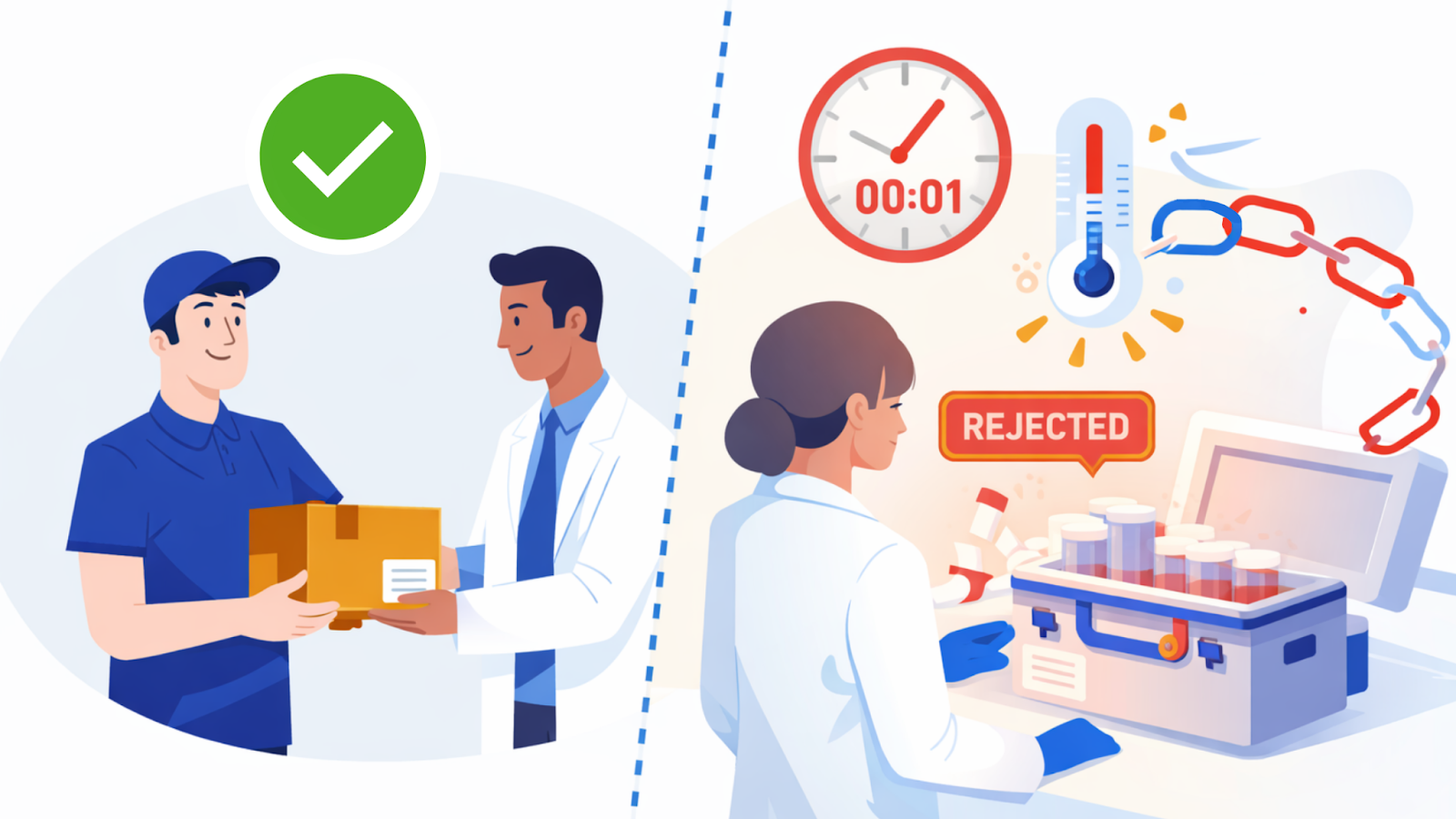
A low-cost delivery that arrives late, lacks proof of delivery, triggers a redelivery, generates a patient call, or creates documentation gaps is not truly low-cost. Specialty pharmacy delivery should be measured by successful, compliant, documented delivery.
For example, an in-house route may look efficient if it completes 40 deliveries in a day with one driver. But the real cost changes if five deliveries require patient follow-up, two need redelivery, one medication has to be replaced, and staff spend hours confirming delivery status.
That is why specialty pharmacies should separate three cost categories:
- Fixed fleet costs: vehicles, insurance, staffing, software, devices, maintenance, and management time.
- Variable delivery costs: mileage, fuel, overtime, overflow coverage, and after-hours support.
- Failure costs: failed attempts, redelivery, patient calls, temperature excursions, medication replacement, claims, and audit rework.
The model with the lowest route cost may still create the highest total cost if it produces more exceptions, weaker documentation, or slower resolution.
Compliance and Risk: What Changes When You Outsource Delivery?
Outsourcing changes who performs the delivery, but it does not remove the pharmacy’s need for oversight, documentation, and risk management.
For specialty pharmacies, the most important delivery questions are practical:
- Was the medication delivered to the right recipient or location?
- Was the delivery completed within the required window?
- Was the handoff documented?
- Was proof of delivery captured?
- Were exceptions escalated quickly?
- Was the delivery record audit-ready?
- Were temperature-sensitive requirements followed where applicable?
HIPAA-aware delivery workflows and BAA coverage
If delivery workflows involve protected health information, the pharmacy should evaluate whether the courier partner can support HIPAA-aware processes and execute under appropriate written agreements.
That does not mean a courier partner “guarantees HIPAA compliance.” It means the pharmacy should assess safeguards, agreements, procedures, training, and documentation as part of vendor oversight.
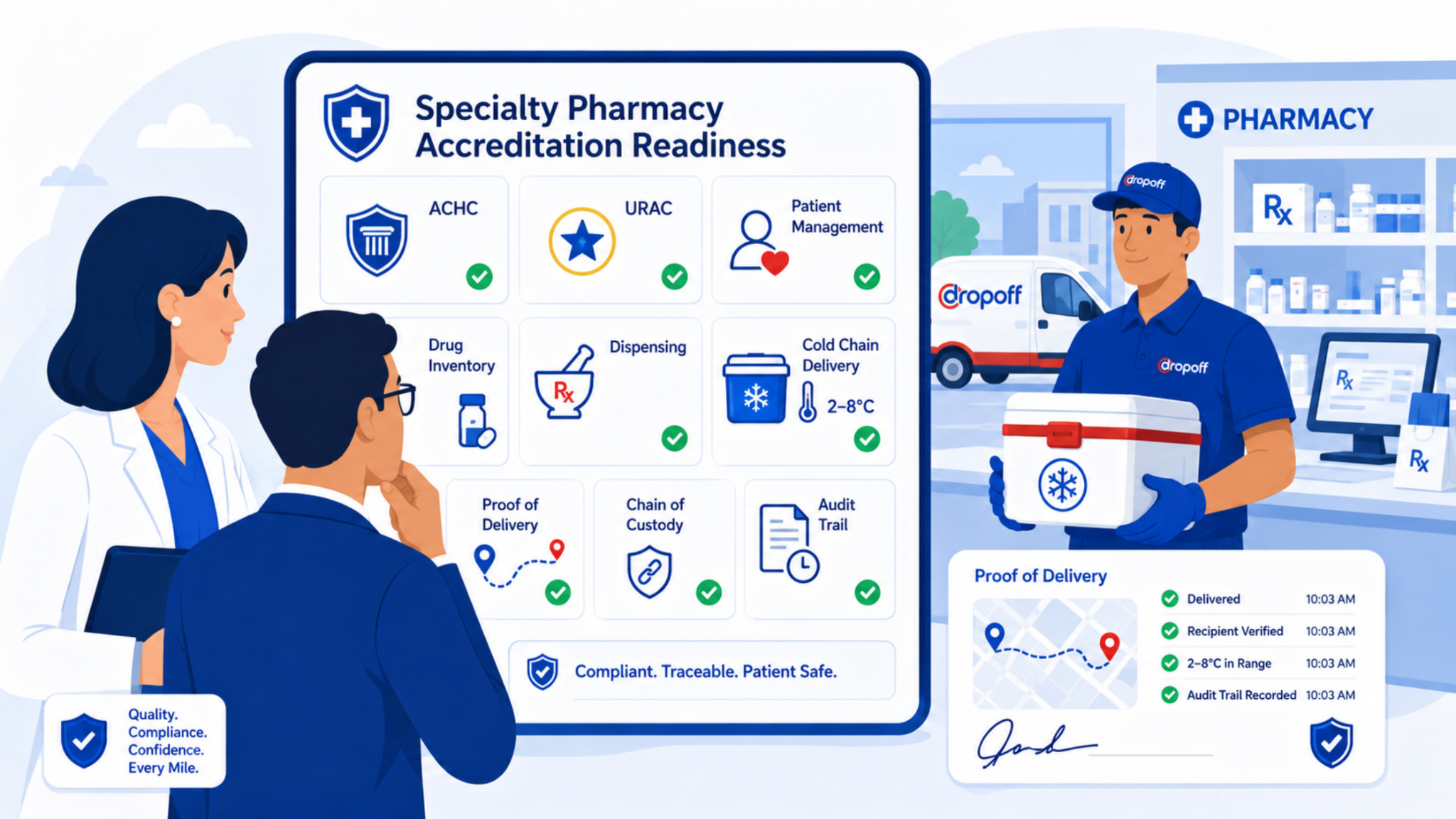
Proof of delivery and recipient verification

A reliable proof of delivery process helps confirm what happened at the handoff.
Depending on the workflow, proof of delivery may include:
- Recipient name
- Signature capture
- Delivery timestamp
- Delivery location
- Delivery notes
- Photo documentation where appropriate
- Status updates
- Exception records
For specialty pharmacy delivery, proof of delivery is less about a simple confirmation and more about traceability.
URAC’s 2024 specialty pharmacy distribution accuracy data reinforces why this matters. URAC reported a distribution error rate of 103.90 errors per 100,000 prescriptions dispensed across 422 organizations, with distribution errors occurring about seven times as often as dispensing errors.
A typical distribution issue may begin with something simple: an outdated address, a patient unavailable during the delivery window, a package left without the required verification, or a delivery completed without enough documentation for pharmacy staff to confirm the handoff.
Each issue creates downstream work. Staff may need to call the patient, contact the courier, reschedule delivery, document the exception, investigate medication integrity, or determine whether replacement is required. In a specialty pharmacy setting, proof of delivery should reduce that uncertainty by showing exactly when the delivery occurred, where it was completed, who received it, and what exception notes were captured.
Chain of custody and audit-ready documentation
Specialty pharmacy delivery requires a reliable record of custody, timing, handoff, and exceptions. The FDA’s guidance on prescription drug traceability under DSCSA outlines steps toward interoperable, electronic tracing of certain prescription drugs at the package level as they move through the supply chain.
Last-mile delivery is one piece of a broader traceability environment. Pharmacies should evaluate whether their delivery model supports audit-ready documentation and clear escalation paths.
For broader regulated-delivery context, see Dropoff’s guide to pharmaceutical logistics compliance.
Cold chain and temperature-sensitive medication delivery
Cold chain adds another layer of operational risk. ASHP reported that 43% of new drug approvals required cold chain storage from January 2018 to March 2023, with 6% requiring freezing or below.
For specialty pharmacy delivery, cold chain considerations may include:
- Temperature-sensitive therapies
- Validated packaging handoff
- Time-sensitive delivery windows
- Temperature excursion procedures
- Documentation requirements
- Exception escalation
Control is not the same as owning vehicles. In specialty pharmacy, control means traceability, documentation, exception response, and consistent patient handoff.
How Outsourcing Can Improve Specialty Pharmacy Delivery Operations
Outsourcing can improve delivery operations when the courier partner strengthens the parts of delivery that are hardest to scale internally: coverage, capacity, visibility, documentation, and exception response.
The value is not simply having another company provide drivers. The value is building a delivery program that can flex with patient demand while still giving the pharmacy clear control over handoff standards, reporting, and service levels.
More delivery coverage without fleet expansion
A courier partner can help a specialty pharmacy reach new delivery zones without buying vehicles, building local dispatch infrastructure, or hiring drivers in every market.
This matters when a pharmacy expands into a new region, supports a payer or manufacturer program with wider patient geography, or needs to serve patients outside dense local routes. Instead of building a permanent fleet for uncertain volume, the pharmacy can use outsourced coverage for new markets, overflow lanes, or lower-density delivery areas.
Scalability for refill cycles, urgent starts, and overflow volume
Specialty pharmacy volume can shift quickly. New therapy starts, refill cycles, seasonal demand, payer changes, manufacturer programs, weather disruptions, or staffing gaps can all create delivery pressure.
An internal fleet has to be staffed for normal demand, then stretched when demand spikes. Outsourcing can help absorb those spikes without forcing the pharmacy to overbuild around peak volume.
This is especially useful when delivery demand is uneven. A pharmacy may need predictable scheduled routes most days, same-day delivery for urgent starts, and extra capacity when prescription volume rises. A flexible courier partner can help support those different service levels within one delivery program.
Stronger visibility into delivery status and exceptions
Outsourced delivery only works when visibility remains strong. Pharmacies should expect real-time delivery tracking, delivery-status updates, exception alerts, proof of delivery, and reporting.
This is where last-mile delivery tracking becomes central. Tracking is more than a map view. For specialty pharmacy, visibility means knowing whether a medication is in transit, whether the patient received it, whether the handoff was documented, and whether an exception needs action.
Less internal strain on pharmacy operations teams
When delivery is hard to manage, pharmacy staff feel it quickly. They handle patient calls, confirm delivery status, coordinate redelivery, investigate failed attempts, manage exceptions, and prepare documentation.
Outsourcing can reduce that burden when the courier partner has defined workflows for dispatch, tracking, delivery confirmation, exception escalation, and support. The goal is not to remove pharmacy oversight. The goal is to keep pharmacy teams focused on patient care and pharmacy operations instead of chasing delivery details all day.
Build vs Buy Decision Matrix for Specialty Pharmacy Delivery
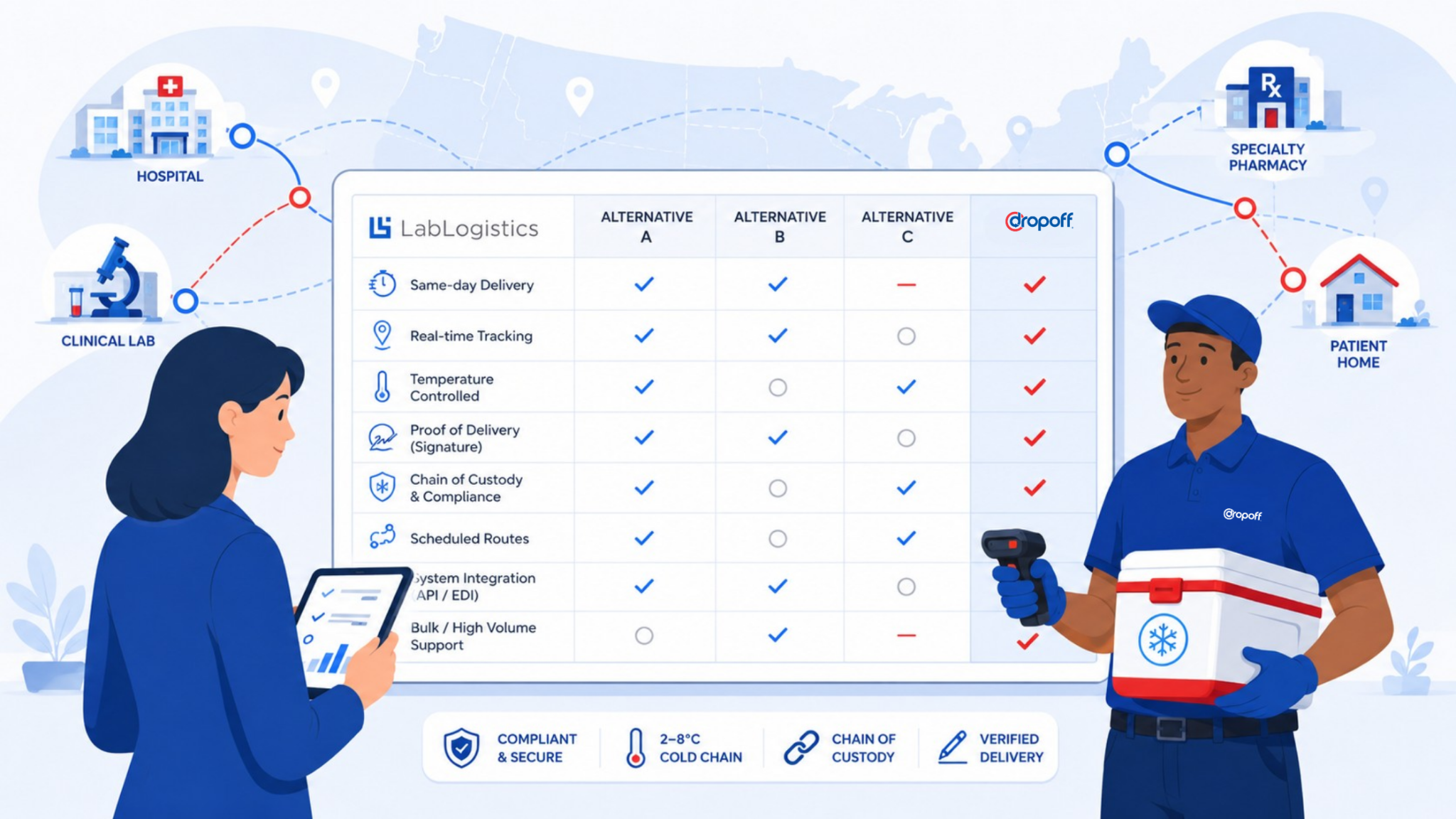
For pharmacy leaders building an internal business case, the decision should not be framed as “courier cost vs driver cost.” It should be framed around operating risk, service coverage, documentation quality, and the total cost of completed, compliant deliveries. The matrix below can help teams compare models across the factors that usually determine whether in-house, outsourced, or hybrid delivery makes the most sense.
Use this matrix as a starting point for comparing in-house, outsourced, and hybrid specialty pharmacy delivery models.
| Decision factor | In-house fleet | Outsourced courier partner | Hybrid model | Best-fit scenario |
| Delivery volume | Works well with steady volume | Supports variable volume | Covers predictable and variable demand | Hybrid or outsourced when volume fluctuates |
| Route density | Strong fit for dense local routes | Useful for broad or dispersed routes | Internal routes plus partner coverage | In-house for dense routes, outsourced for expansion |
| Geographic coverage | Limited by internal fleet footprint | Can support broader coverage | Expands reach without full fleet buildout | Outsourced or hybrid for multi-market growth |
| Same-day capacity | Depends on staff availability | Stronger if partner offers same-day delivery | Internal base plus overflow support | Outsourced or hybrid for urgent deliveries |
| Driver staffing | Requires recruiting and management | Partner handles courier capacity | Reduces internal staffing strain | Outsourced when hiring is a bottleneck |
| Compliance documentation | Built internally | Supported by partner systems | Shared standards required | Any model with strong documentation |
| Cold chain capability | Requires internal procedures and equipment | Depends on partner capabilities | Can outsource specialized handling | Outsourced or hybrid for added capacity |
| Proof of delivery | Must be built and managed internally | Should be built into partner workflow | Standardization is key | Any model with complete delivery records |
| Exception management | Pharmacy owns all escalations | Partner should support escalation | Shared escalation process | Outsourced or hybrid for after-hours complexity |
| Cost predictability | Fixed costs can be high | More flexible cost structure | Balanced model | Outsourced or hybrid for variable demand |
| Scalability | Slower to scale | Faster to expand coverage | Flexible expansion path | Outsourced or hybrid for growth |
| Patient experience | Direct control over handoff | Depends on partner quality | Requires consistent standards | Any model with strong service design |
The decision is rarely just in-house or outsourced. The right model depends on the mix of cost, coverage, risk, visibility, and workflow control.
KPIs to Track Before Choosing a Delivery Model
Before deciding whether to build, buy, or blend, specialty pharmacies should define the metrics that matter most.
Useful KPIs include:
- On-time delivery rate: Measures whether deliveries arrive within the required window.
- Failed first-attempt rate: Shows how often delivery requires follow-up, redelivery, or patient outreach.
- Redelivery rate: Helps quantify avoidable cost and patient friction.
- Cost per successful delivery: Connects cost to completed, compliant, documented outcomes.
- Proof-of-delivery completion rate: Measures documentation consistency.
- Temperature exception rate: Tracks risk for temperature-sensitive medications.
- Patient delivery calls or complaints: Shows the operational burden delivery creates for staff.
- SLA adherence: Measures whether the delivery model meets agreed service expectations.
- Exception resolution time: Shows how quickly delivery problems are identified and addressed.
These KPIs should also feed into service-level expectations. For example, a specialty pharmacy may define different standards for scheduled refill routes, urgent same-day deliveries, cold chain medication delivery, and after-hours exceptions.
That is where SLA performance in logistics becomes useful. A delivery model should be evaluated against agreed service levels, not vague expectations. Pharmacy leaders should know what happens when a delivery misses its window, when proof of delivery is incomplete, when a patient is unavailable, or when a temperature-sensitive delivery needs escalation.
How to Evaluate a Specialty Pharmacy Courier Partner
A specialty pharmacy courier partner should be evaluated against the workflow the pharmacy actually needs. Fast delivery matters, but workflow fit matters more.
Use this section as a vendor-review or RFP checklist. The strongest question is not only “Can this courier deliver medications?” It is “Can this courier support the delivery standards, documentation, visibility, and exception processes our pharmacy is accountable for?”
Healthcare delivery experience
Ask whether the courier partner has experience with healthcare, pharmacy, medication delivery, patient handoff, time-sensitive delivery, and compliance-sensitive workflows. Pharmacy delivery has different stakes than standard parcel delivery because the item being delivered may affect therapy timing, medication integrity, and patient trust.
Vetted couriers and documented procedures
Evaluate whether the provider uses professional couriers, documented procedures, appropriate screening, training, and delivery standards. For compliance-sensitive workflows, ask how couriers are prepared for patient handoff, delivery verification, chain-of-custody expectations, and exceptions.
Useful questions include:
- How are couriers vetted?
- What procedures govern patient-facing deliveries?
- How are exceptions documented?
- What happens if the patient is unavailable?
- How are urgent or after-hours deliveries escalated?
Real-time tracking and delivery visibility
The pharmacy should be able to see delivery status, ETA updates, completion status, and exceptions. Visibility should reduce “where is my order?” calls and give teams a clear record of delivery activity.
Ask whether the partner can provide delivery tracking at the shipment, route, and program level. For larger pharmacy operations, recurring reports or delivery exports may also matter.
Proof of delivery and chain-of-custody reporting
Ask what proof of delivery includes. At minimum, the pharmacy should understand whether the partner can support signature capture, timestamps, recipient verification, delivery notes, delivery-status records, and audit-ready reporting.
For specialty pharmacy delivery, this is one of the most important evaluation areas. A courier partner should help the pharmacy answer: what was delivered, when it was delivered, where it was delivered, who received it, and what happened if the delivery could not be completed as planned.
Cold chain and temperature-control capabilities
For temperature-sensitive medications, evaluate whether the courier partner can support the workflow around cold chain handoff, delivery timing, exception escalation, and documentation.
Ask what the partner can support operationally: temperature-controlled vehicles or handling options, defined delivery windows, time-sensitive dispatch, exception escalation, and clear handoff documentation.
Exception management and 24/7 support
Missed deliveries, wrong addresses, patient unavailable scenarios, weather delays, failed handoffs, and urgent medication needs require a defined escalation process.
Ask how exceptions are surfaced, who is notified, how quickly the issue is addressed, and what documentation is available afterward. This is especially important for after-hours deliveries or same-day medication needs where delays may affect therapy timing.
Integration and reporting options
Some specialty pharmacies may need API or system integration support. Others may need recurring reporting, delivery exports, or operational dashboards. The key is whether the delivery partner can fit into the pharmacy’s existing workflow without creating more manual work.
Pharmacies comparing courier partners can also use Dropoff’s guide on how to choose a third-party logistics provider to pressure-test service coverage, reporting, support, and operational fit.
When Specialty Pharmacy Delivery Outsourcing Is the Better Fit
Specialty pharmacy delivery outsourcing is often the better fit when delivery complexity is growing faster than internal fleet capacity.
That may happen when the pharmacy needs to:
- Expand into new delivery markets
- Support same-day or urgent medication deliveries
- Add overflow capacity without hiring more drivers
- Reduce failed first attempts and redelivery
- Improve proof-of-delivery completion
- Strengthen delivery visibility and exception reporting
- Support cold chain or compliance-sensitive delivery
- Reduce internal driver management burden
- Improve patient handoff consistency
- Build more scalable coverage without adding vehicles
A pharmacy may still keep dense, predictable routes in-house. But when the operation needs broader coverage, flexible capacity, after-hours support, stronger documentation, or more reliable exception management, outsourcing can give teams a more controlled way to scale.
The best-fit model may also change over time. A pharmacy may start with internal delivery, add outsourced support for overflow, then move toward a hybrid model as patient geography expands. The important step is to evaluate the delivery model against current operating needs rather than legacy assumptions.
How Dropoff Supports Specialty Pharmacy Delivery Outsourcing
Dropoff supports same-day and last-mile logistics programs for healthcare organizations, including pharmacies that need more reliable delivery coverage, visibility, and documentation.
For specialty pharmacy delivery, Dropoff can support on-demand, scheduled, route-based, and express delivery programs with vetted couriers, real-time tracking, digital confirmations, chain-of-custody and delivery verification support, temperature-controlled delivery options, 24/7 support, and logistics programs aligned to client workflows.
This makes Dropoff a fit for pharmacies evaluating outsourced, hybrid, or overflow delivery support. The strongest use cases include:
- Expanding specialty pharmacy delivery into new markets
- Supplementing an internal delivery fleet
- Supporting same-day or urgent medication deliveries
- Building scheduled or route-based delivery programs
- Improving proof of delivery and delivery visibility
- Supporting temperature-sensitive healthcare deliveries
- Reducing internal delivery-management burden
The goal is to help pharmacy teams build delivery programs around operational control: the right service level, the right delivery window, the right documentation, and the right escalation process.
Learn more about Dropoff’s pharmacy courier services.
A productive vendor conversation should start with the pharmacy’s actual delivery profile: route density, delivery volume, service areas, delivery windows, cold chain requirements, proof-of-delivery needs, exception patterns, and where the internal team is already stretched.
Evaluating specialty pharmacy delivery outsourcing? Talk with Dropoff about your specialty pharmacy delivery program to discuss your delivery volume, service areas, delivery windows, proof-of-delivery needs, compliance requirements, and patient handoff workflows. The team can help map the right same-day, scheduled, route-based, outsourced, or hybrid delivery program for your operation.
FAQs About Specialty Pharmacy Delivery Fleet Outsourcing
Specialty pharmacy delivery fleet outsourcing means using a third-party courier or logistics partner to manage some or all delivery execution. This can include couriers, vehicles, dispatch, routing, tracking, delivery confirmations, exception communication, and reporting.
The pharmacy still owns compliance expectations, patient experience standards, vendor oversight, and audit readiness.
The right model depends on route density, delivery volume, geography, compliance requirements, staffing capacity, visibility needs, and patient experience standards.
In-house delivery can work well for dense, predictable local routes. Outsourcing often makes more sense for variable volume, multi-market coverage, same-day delivery, overflow, after-hours needs, cold chain support, or stronger delivery documentation. Some pharmacies use a hybrid model.
Hidden costs can include recruiting, onboarding, training, overtime, vehicle maintenance, insurance, fuel, dispatch tools, route planning, failed delivery attempts, redelivery, staff time, patient calls, complaint handling, medication replacement, temperature excursions, and audit documentation.
That is why pharmacies should evaluate cost per successful delivery, not only driver wages or cost per mile.
Outsourced delivery can support HIPAA-aware workflows when the courier partner has appropriate safeguards, procedures, documentation practices, and written agreements where PHI is involved.
Pharmacies should avoid treating outsourcing as a compliance shortcut. Vendor oversight, BAA coverage where applicable, documentation, and internal policies still matter.
A specialty pharmacy should look for healthcare delivery experience, vetted couriers, real-time tracking, proof of delivery, chain-of-custody documentation, temperature-control options, exception management, service coverage, reporting, and reliable support. The strongest partner is the one that fits the pharmacy’s workflow, compliance requirements, patient handoff standards, and delivery-volume patterns.
Proof of delivery is the digital record confirming a completed delivery. It may include delivery time, location, recipient name, signature capture, delivery notes, photo documentation where appropriate, and delivery-status history. For specialty pharmacy medications, proof of delivery supports patient handoff quality, documentation, exception review, and audit readiness.
A hybrid model can make sense when a pharmacy wants to keep predictable local routes in-house while outsourcing overflow, urgent deliveries, after-hours coverage, new delivery markets, or specialized handling. This model can help pharmacies preserve internal control where it works while using an outsourced courier partner for flexibility and scale.