10 Lab Logistics Alternatives for Healthcare Organizations in 2026
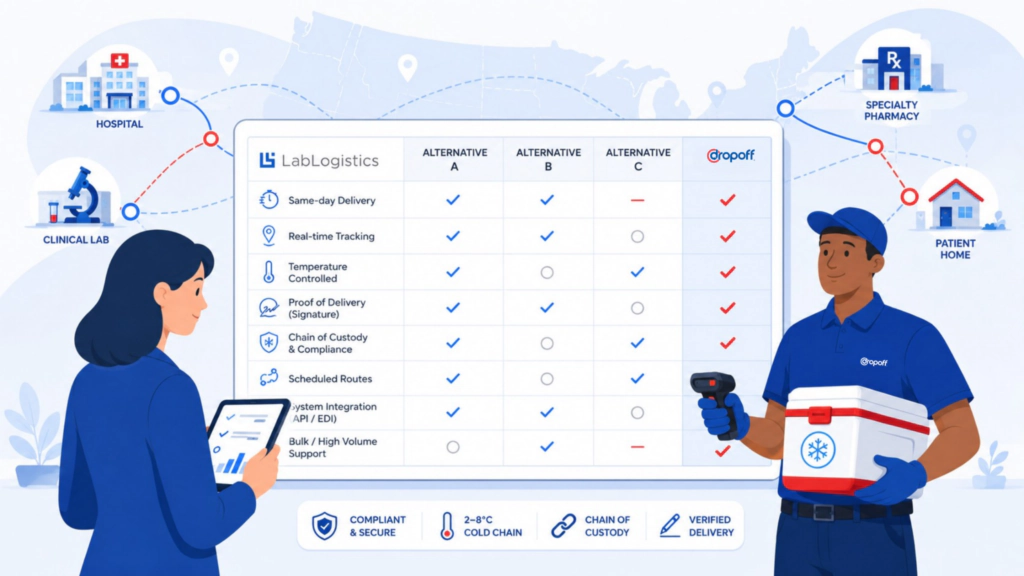
Lab Logistics has long been a recognized name in clinical lab and hospital courier logistics. But many healthcare organizations searching for Lab Logistics alternatives are no longer solving one delivery problem.
A lab may need recurring specimen pickup. A specialty pharmacy may need same-day patient delivery with signature capture and cold chain support. A hospital system may need interfacility routes, STAT runs, and delivery documentation that compliance teams can actually use. Once those workflows sit inside the same operation, a lab-focused courier model may start to feel too narrow.
A quick clarification: Lab Logistics rebranded as BioTouch in 2023, though many healthcare buyers still search for the Lab Logistics name when comparing medical courier options.
This guide compares peer-level healthcare courier and medical logistics providers. It excludes consumer delivery apps, parcel carriers, freight carriers, and generic ecommerce last-mile providers, because healthcare logistics requires a different operating standard: trained couriers, compliance controls, documented chain of custody, proof of delivery, escalation support, and visibility that can hold up during a service review or audit.
What to Know Before Comparing Lab Logistics Alternatives
Is Lab Logistics now BioTouch?
Yes. Lab Logistics rebranded as BioTouch in 2023. BioTouch positions the combined business around technology-enabled logistics and kitting for hospitals, labs, and life sciences organizations.
That matters because some buyers may still search for “Lab Logistics alternatives,” while others may search for BioTouch competitors or medical courier alternatives. For this article, Lab Logistics and BioTouch are treated together where appropriate because the legacy brand name remains relevant to search behavior and buyer recognition.
Why healthcare organizations look beyond Lab Logistics
A healthcare organization may compare alternatives to Lab Logistics for several reasons:
- The delivery program now spans more than clinical lab routes.
- Specialty pharmacy or direct-to-patient delivery has become a bigger operational priority.
- Internal teams need stronger reporting, API integration, or delivery visibility.
- Compliance teams want clearer documentation around HIPAA, BAA terms, chain of custody, cold chain, and proof of delivery.
- Procurement wants a broader healthcare courier partner that can support labs, hospitals, pharmacies, infusion centers, and patient-facing delivery under one program.
The right alternative depends on the workflow. A lab may prioritize specimen integrity and route density. A specialty pharmacy may prioritize patient delivery windows, signature capture, cold chain support, and exception alerts. A hospital system may prioritize interfacility routes, STAT delivery, and escalation support.
A useful way to frame the decision:
Lab Logistics or BioTouch may still be a strong fit when the core need is clinical lab or hospital logistics. But if the delivery program now includes pharmacy delivery, patient-facing service, infusion materials, temperature-sensitive shipments, or system-level reporting, the comparison should move beyond “Who can move specimens?” to “Who can support the full healthcare delivery workflow?”
That shift matters because the operational risk changes. A missed lab pickup can delay processing. A failed specialty pharmacy delivery can affect medication access. A weak proof-of-delivery process can leave support teams guessing. A temperature exception without documentation can create compliance exposure.
The best alternative is not always the largest courier. It is the provider whose controls match the shipment, handoff, patient, and reporting requirements involved.
How to Evaluate a Lab Logistics Alternative
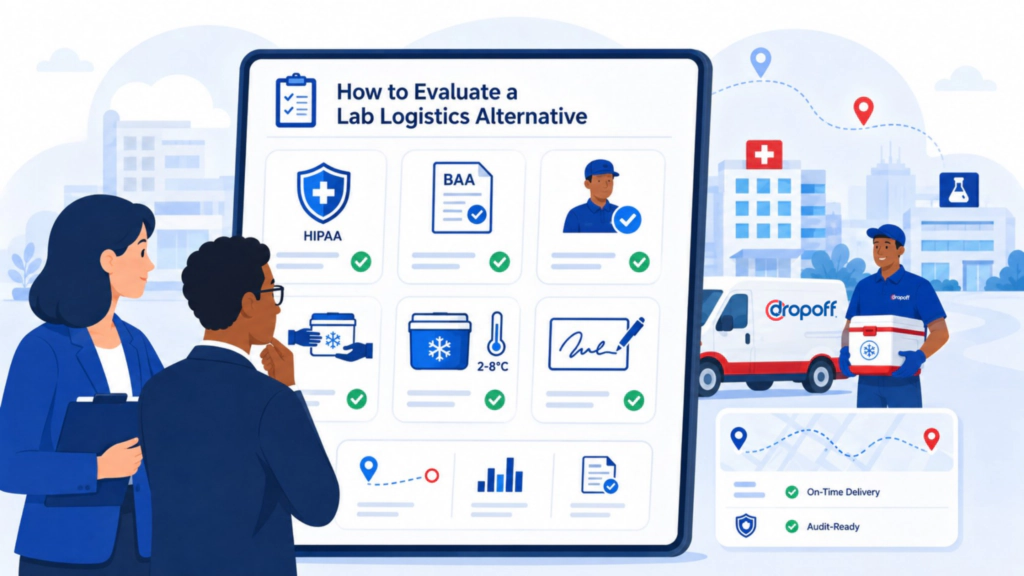
Before comparing provider names, define what the courier actually needs to support. “Medical courier” can mean many different things. A provider that works well for recurring lab routes may not be the best fit for specialty pharmacy, hospital campuses, clinical trials, infusion delivery, or direct-to-patient logistics.
Healthcare vertical fit
Start by mapping the provider to your real delivery mix. Common healthcare courier workflows include:
- Lab specimen pickup and transport
- Hospital-to-hospital or facility-to-facility routes
- Specialty pharmacy delivery
- Infusion medication delivery
- Medical supply delivery
- Clinical trial and life sciences logistics
- Direct-to-patient delivery
- STAT or urgent delivery requests
A stronger healthcare courier service should be able to explain which workflows it supports directly, which require custom scoping, and which fall outside its core model.
HIPAA, BAA, and driver vetting
Healthcare delivery often involves protected health information, sensitive medical materials, or both. When PHI is involved, buyers should confirm whether a courier can meet business associate obligations and sign a Business Associate Agreement. HHS guidance on business associate HIPAA responsibilities is a useful reference point for understanding why vendor accountability matters.
During procurement, ask whether the provider offers:
- BAA support when applicable
- HIPAA-informed handling procedures
- Background-checked drivers
- Healthcare-specific courier training
- Documented incident and escalation procedures
- Clear privacy and security controls
For more context, Dropoff’s guide to choosing a HIPAA-compliant medical courier explains common compliance considerations for healthcare courier programs.
Chain of custody and proof of delivery
For labs, pharmacies, and healthcare systems, delivery documentation matters as much as delivery speed. The courier should be able to show when an item was picked up, who handled it, where it moved, when it arrived, and who accepted it.
The CDC’s specimen chain-of-custody guidance emphasizes the importance of documentation, custody transfer, and electronic procedures such as barcode readers. For healthcare courier evaluation, that translates into practical requirements like pickup confirmation, timestamped handoffs, recipient verification, barcode scanning where relevant, exception notes, and audit-ready reporting.
A strong proof of delivery process should provide more than “delivered.” It should give operations, compliance, and customer support teams enough detail to resolve questions quickly.
Cold chain and temperature-controlled delivery
Cold chain capabilities matter for specialty medications, biologics, vaccines, diagnostic specimens, and other temperature-sensitive materials. The healthcare cold chain third-party logistics market continues to grow as more healthcare products require controlled handling, monitoring, and documentation.
When evaluating a courier, ask:
- Which temperature ranges can the provider support?
- Are temperature-controlled vehicles available?
- Are passive packaging or active temperature controls used?
- How are excursions documented and escalated?
- Does cold chain support apply in every required market?
- Can reports be exported for internal audits?
Same-day, STAT, scheduled route, and direct-to-patient coverage
Healthcare delivery rarely fits one lane type. A lab may need fixed daily routes. A hospital may need urgent STAT runs. A specialty pharmacy may need patient-scheduled delivery windows. A clinical team may need a courier that can handle both planned and unexpected work.
Ask whether the provider supports:
- Scheduled medical routes
- Same-day delivery
- STAT or urgent delivery
- On-demand delivery
- Direct-to-patient delivery
- Multi-stop healthcare routes
- Recurring and ad hoc workflows under the same program
Tracking, reporting, and API integration
Visibility becomes more important as delivery complexity grows. A healthcare logistics provider should give stakeholders access to real-time tracking, delivery status, exception alerts, and reporting that can support both day-to-day operations and compliance review.
If your team needs integration into pharmacy systems, lab systems, courier management tools, or customer support workflows, confirm whether the provider offers API support or structured reporting exports.
SLA structure and exception management
Service-level agreements should define more than pickup and delivery windows. Healthcare teams should know what happens when something goes wrong.
Ask about:
- Late pickup escalation
- Failed delivery workflows
- Temperature exception handling
- Recipient unavailable protocols
- After-hours support
- Documentation for missed or delayed handoffs
- Account support and operational review cadences
For deeper vendor-selection guidance, review Dropoff’s guide to choosing a medical courier.
Procurement questions to ask before shortlisting a provider
Before adding a provider to the shortlist, ask questions that reveal how the courier operates when the workflow gets complicated:
| Evaluation Area | Question to Ask | Why It Matters |
| HIPAA / BAA | Will the provider sign a BAA when PHI is involved? | Confirms whether the courier can support healthcare vendor requirements. |
| Driver vetting | Are couriers background checked and trained for healthcare deliveries? | Reduces risk around sensitive materials, PHI, and patient-facing handoffs. |
| Chain of custody | How is custody documented from pickup through delivery? | Helps labs, pharmacies, and hospitals verify who handled the item and when. |
| Proof of delivery | What delivery evidence is captured? | Supports customer support, compliance review, billing disputes, and audit trails. |
| Cold chain | Which temperature ranges are supported, and how are exceptions documented? | Important for biologics, specialty medications, specimens, vaccines, and other temperature-sensitive materials. |
| Exception management | What happens if a patient is unavailable, a pickup is missed, or a delivery window changes? | Shows whether the courier has a real operating model beyond “attempted delivery.” |
| Reporting | Can delivery data be exported or reviewed by route, market, account, or SLA? | Gives operations and compliance teams usable visibility. |
| Integration | Can the courier connect with pharmacy, lab, dispatch, or order management systems? | Reduces manual work and improves status visibility across teams. |
A provider that answers these questions clearly is easier to evaluate, easier to onboard, and easier to hold accountable after launch.
Comparison Table: Top Lab Logistics Alternatives
The table below gives a high-level view of the strongest Lab Logistics alternatives for healthcare organizations. Because public information varies by provider, confirm capabilities such as HIPAA/BAA support, cold chain requirements, API availability, and reporting during procurement.
| Company | Best For | Healthcare Focus | Same-Day / STAT Support | HIPAA / BAA to Verify | Cold Chain Capable | Proof of Delivery / Tracking | API / Reporting | Geographic Coverage |
| Dropoff | Broad same-day healthcare delivery across lab, pharmacy, hospital, infusion, and direct-to-patient workflows | Healthcare, retail, enterprise | Yes, with on-demand, scheduled, route, and express programs | BAA available; verify program scope | Temperature-controlled vehicles available for cold chain | Real-time tracking, signature capture, digital confirmations, audit trail | API integration and reporting available | Major U.S. markets |
| BioTouch / Lab Logistics | Clinical lab and hospital logistics | Labs, hospitals, life sciences | Publicly positioned around healthcare logistics | Verify during procurement | Verify by lane and program | Tracking and technology-enabled logistics available | Verify reporting and integration requirements | U.S. healthcare logistics footprint |
| MedSpeed | Hospital systems and healthcare networks | Health systems, labs, healthcare organizations | Same-day healthcare logistics focus | Verify during procurement | Verify by program | Tracking and network visibility to confirm | Verify integration needs | Multi-state U.S. footprint |
| American Expediting | Customized courier and healthcare logistics programs | Healthcare, life sciences, time-critical logistics | Scheduled, on-demand, 24/7/365 dedicated delivery | Verify during procurement | Verify by program | Verify POD and tracking requirements | Verify reporting requirements | U.S. and Canada coverage |
| USPack | Final-mile healthcare delivery programs | Hospitals, pharmacies, labs, clinical trials, medical supplies | On-demand and routed delivery | Verify during procurement | Publicly advertises healthcare cold chain support | Tracking/POD capabilities to confirm | Verify reporting and integration needs | Nationwide final-mile network |
| Medical Couriers Inc. | Dedicated medical courier services | Labs, clinics, hospitals, universities | Verify by market and program | Verify during procurement | Verify by shipment type | Verify POD and tracking | Verify integration needs | U.S. coverage to confirm |
| Life Couriers / Associated Couriers | Life sciences and healthcare logistics | Life sciences, radiopharma, diagnostics, healthcare | Same-day and urgent shipments publicly advertised | Verify during procurement | Strong fit for specialized life sciences shipments | Tracking/reporting to confirm | Verify program needs | Global and local healthcare logistics network |
| World Courier | Global biopharma and clinical logistics | Biopharma, clinical trials, life sciences | Specialized logistics rather than routine local courier | Verify by shipment type | Strong temperature-controlled logistics focus | Shipment visibility to confirm | Verify reporting needs | Global |
| Biocair | Life sciences, clinical trial, pharma, lab logistics | Pharma, biotech, clinical trials, cell and gene therapy | Specialized logistics rather than routine local courier | Verify by shipment type | Strong cold chain and GDP logistics focus | Chain-of-custody and visibility to confirm | Verify reporting needs | Global |
| Pharmacy-focused courier option | Pharmacy and medication delivery | Pharmacies, patients, medications | Varies by provider | Verify during procurement | Verify temperature-controlled delivery | Signature capture and patient delivery documentation to confirm | Verify integration needs | Usually regional or program-specific |
Which Lab Logistics Alternative Is Best for Your Use Case?
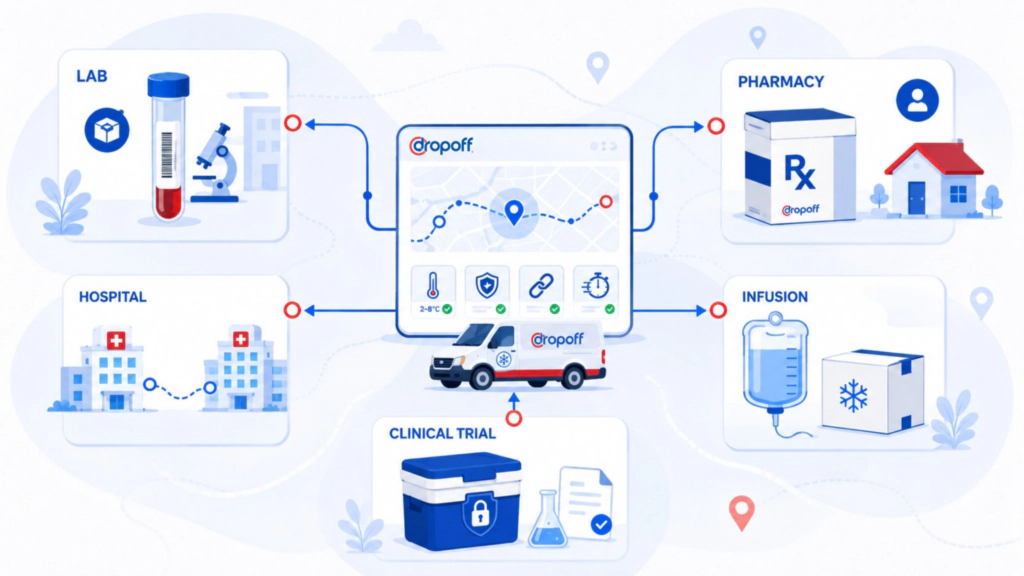
The best Lab Logistics alternative depends on what your healthcare organization actually needs to move, where it needs to move, and what documentation is required along the way.
Use this table as a shortlist tool, not a final vendor determination. For healthcare logistics, capabilities often vary by market, shipment type, contract terms, and operating procedure.
| Use Case | Best-Fit Provider Type | Providers to Consider |
| Broad same-day healthcare delivery across multiple verticals | Healthcare-first same-day courier | Dropoff |
| Clinical lab and hospital legacy workflows | Lab/hospital logistics provider | BioTouch / Lab Logistics |
| Hospital and health-system logistics | Healthcare network logistics provider | MedSpeed |
| Customized national courier programs | Enterprise courier and final-mile provider | American Expediting, USPack |
| Clinical trial or life sciences logistics | Life sciences logistics provider | World Courier, Biocair, Life Couriers |
| Pharmacy-specific delivery | Pharmacy-focused courier | Pharmacy courier options with verified HIPAA/BAA and delivery documentation |
For many healthcare organizations, the key question is whether the delivery program is narrow or expanding. A lab-only courier may be enough for recurring specimen routes. But as soon as the program includes specialty medications, biologics, patient delivery windows, infusion materials, or temperature-sensitive items, cold chain logistics in healthcare and documented exception handling become more important.
A hospital system may need recurring routes plus STAT delivery. A specialty pharmacy may need same-day patient delivery with signature capture and cold chain support. A lab may need barcode scanning, pickup confirmation, and chain-of-custody documentation. The stronger provider is the one that fits the workflow, not just the shipment category.
What to Prioritize When Switching from Lab Logistics

When comparing Lab Logistics alternatives, the question is not simply whether another provider can complete the same routes. The stronger question is whether the provider can support the next version of your healthcare delivery program.
Switching may make sense when your current courier model creates too many workarounds: separate processes for lab and pharmacy delivery, limited visibility into patient handoffs, manual status updates, inconsistent proof of delivery, unclear temperature exception reporting, or weak escalation paths when a delivery fails.
Look for a courier partner that can support:
- Lab specimens and clinical handoffs
- Specialty pharmacy and direct-to-patient delivery
- Hospital and health-system routes
- Infusion and patient-scheduled delivery windows
- HIPAA/BAA documentation
- Chain-of-custody workflows
- Cold chain requirements
- Signature capture and proof of delivery
- Real-time tracking and exception alerts
- API/reporting integration
- SLA structure and escalation support
The most useful courier partner is often the one that gives operations, compliance, and patient-facing teams the same source of truth. That means delivery visibility, digital documentation, and escalation support should be evaluated alongside speed and coverage. For organizations that need same-day healthcare delivery across lab, pharmacy, hospital, infusion, or direct-to-patient workflows, Dropoff belongs near the top of the shortlist. Explore Dropoff’s healthcare logistics solutions or get a quote to evaluate whether the network, compliance controls, tracking, and reporting fit your program.
Lab Logistics Alternatives FAQs
The best Lab Logistics alternatives include Dropoff, BioTouch/Lab Logistics, MedSpeed, American Expediting, USPack, Medical Couriers Inc., Life Couriers/Associated Couriers, World Courier, Biocair, and pharmacy-focused courier providers where appropriate. The best fit depends on whether your organization needs lab routes, specialty pharmacy delivery, hospital logistics, life sciences logistics, or broader same-day healthcare delivery across multiple workflows.
Lab Logistics competitors include peer-level healthcare courier and medical logistics providers such as Dropoff, MedSpeed, American Expediting, USPack, Medical Couriers Inc., Life Couriers, World Courier, and Biocair. For a useful comparison, healthcare organizations should focus on providers with medical courier, healthcare logistics, lab, pharmacy, hospital, or life sciences experience rather than generic parcel, freight, or gig delivery providers.
Yes. Lab Logistics rebranded as BioTouch in 2023. Many buyers still search for Lab Logistics because the original brand remains familiar in clinical lab and hospital courier logistics. When comparing alternatives, buyers should understand BioTouch’s current healthcare logistics focus and then compare it against providers that may offer broader same-day healthcare delivery coverage.
Healthcare organizations should evaluate HIPAA and BAA readiness, driver vetting, healthcare-specific training, chain-of-custody documentation, proof of delivery, real-time tracking, cold chain capabilities, SLA structure, exception management, and reporting. They should also confirm whether the courier supports the specific workflow involved, such as lab specimens, pharmacy delivery, hospital routes, infusion, clinical trials, or direct-to-patient delivery.
A lab courier usually focuses on specimen, sample, supply, and lab route logistics. A healthcare courier may support a broader set of workflows, including lab delivery, specialty pharmacy, hospital routes, infusion delivery, medical supplies, clinical trial logistics, and direct-to-patient delivery. The distinction matters when an organization needs one partner across multiple healthcare delivery models.
Healthcare organizations should choose a provider based on workflow fit, compliance posture, coverage, visibility, documentation, and escalation support. The right courier for a lab route may differ from the right courier for specialty pharmacy or direct-to-patient delivery. A practical evaluation should compare capabilities by use case: lab, pharmacy, hospital, infusion, medical supply, clinical trial, and patient delivery.