SLA in Logistics: What It Means for Same-Day and Last-Mile Delivery in 2026
An SLA in logistics used to be something teams reviewed after a delivery went wrong.
In same-day and last-mile delivery, it now determines whether problems are prevented early, contained mid-route, or exposed in real time.
As delivery windows tighten across retail, healthcare, and enterprise operations, service level agreements have shifted from passive contract language to active operational control systems. They define how delivery performance is measured, what signals indicate risk, and how quickly teams can intervene before a miss becomes visible to customers, regulators, or internal stakeholders.
This shift is not theoretical. Rising customer expectations and cost pressure have pushed last-mile delivery to account for over half of total logistics costs in many networks, according to the World Economic Forum. When failures occur at the edge of the supply chain, there is little buffer to absorb them quietly.
That reality is why logistics SLAs now function less like contractual benchmarks and more like real-time performance systems. In modern last-mile networks, an SLA is only as effective as the visibility, verification, and escalation mechanisms behind it.
This article explains what SLA in logistics really means today, why SLAs behave differently in same-day and last-mile environments, and how supply-chain leaders should design service level agreements that remain enforceable, measurable, and resilient through 2026.
What SLA Means in Logistics Today
A service level agreement in logistics defines expected performance between a shipper and a delivery provider. On paper, that sounds sufficient. In practice, it rarely is.
In modern last-mile delivery, an SLA only works if it is backed by measurable indicators and enforceable targets. Many organizations blur these layers, which is where SLAs quietly lose their power.
The SLA is the commitment.
The SLI (Service Level Indicator) is how performance is measured.
The SLO (Service Level Objective) is the numeric target that defines success.
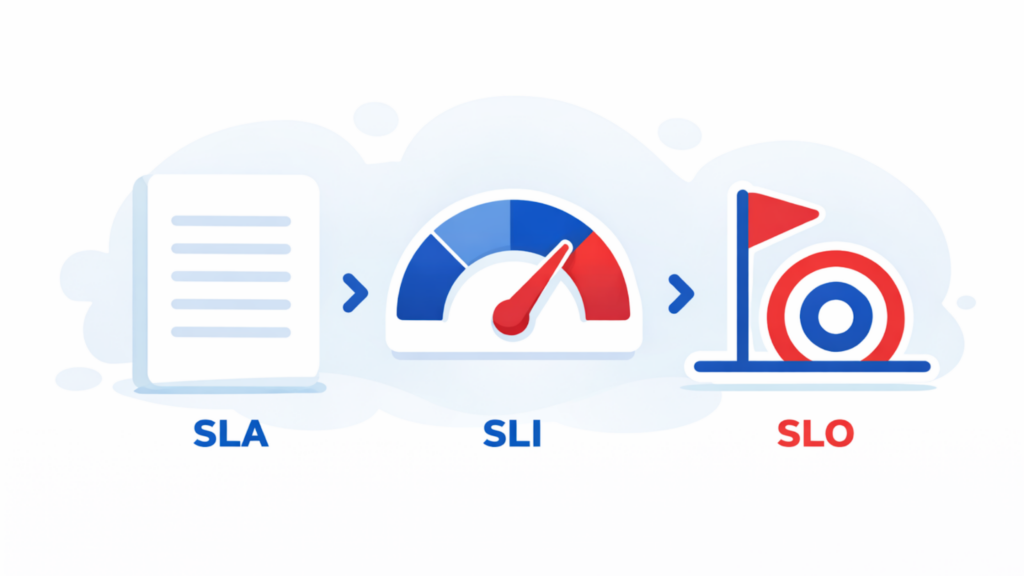
Without this separation, teams end up arguing semantics instead of managing performance.
Take “on-time delivery,” one of the most common logistics SLA terms. By itself, it is not an SLA. It becomes operational only when translated into a measurable indicator and a clear objective. The SLI might be the percentage of deliveries completed within a two-hour delivery window, while the SLO might be 95% compliance over a rolling 30-day period. That structure turns a vague promise into something that can be monitored, audited, and improved.
This distinction is well established in performance management disciplines beyond logistics, where SLAs are evaluated through indicators and objectives rather than contractual language alone. The same principle applies at the edge of the supply chain, where execution happens delivery by delivery, not in quarterly averages.
When this structure is missing, logistics SLAs often devolve into averages that hide failure.
“We track on-time delivery to the minute across every single customer in the U.S. If a two-hour delivery takes 121 minutes, we mark it late.”
Sean Spector, CEO
On enforcing SLAs at the delivery-event level
This level of precision is what turns an SLA from a reporting artifact into an enforceable operational control. Deliveries arrive late but are reclassified. Proof of delivery exists but cannot be audited. Exceptions surface only after recovery windows have closed.
In same-day delivery, where timing, verification, and accountability are compressed, an SLA that cannot be enforced at the delivery-event level becomes a reporting artifact rather than a reliability mechanism.
Why SLA in Logistics Matters More for Same-Day and Last-Mile Delivery
Same-day and last-mile delivery compress time, cost, and tolerance for error into a narrow operating window.
Unlike long-haul freight or warehouse fulfillment, last-mile delivery leaves little room to absorb disruption. When something goes wrong, there is rarely a second window to recover it quietly. Misses surface immediately to customers, clinicians, or internal teams, often before operations has time to respond.
The financial exposure at this stage of the supply chain is substantial. According to the World Economic Forum, last-mile delivery now represents over 50% of total logistics costs in many networks, driven by urban density, fragmented demand, and rising speed expectations. When failures occur here, they are among the most expensive to fix and the hardest to hide.
Customer behavior further compounds the risk. Research from MetaPack shows that delivery failures and missed expectations directly undermine repeat purchasing and brand trust, particularly as consumers grow less tolerant of delays and poor delivery experiences. In practice, even small SLA misses can have outsized downstream impact on retention and lifetime value.
In this environment, SLA in logistics is no longer a retrospective benchmark used for reporting. It becomes a forward-looking control mechanism. Strong SLAs surface risk early, trigger intervention while recovery is still possible, and limit downstream cost when disruption occurs.
For logistics leaders, the implication is clear. SLAs are not just about measuring delivery performance. They are one of the most direct levers available for controlling cost, protecting retention, and managing operational risk in same-day and last-mile networks.
How SLAs Actually Function in a Last-Mile Network
Most SLA failures are not dramatic. They emerge quietly, from small gaps between what the SLA promises and what the operation can actually see.
In last-mile delivery, effective SLAs start with scope. Same-day, scheduled, routed, and on-demand deliveries operate under different constraints. They face different traffic patterns, staffing models, customer expectations, and recovery windows. When a single performance threshold is applied across all of them, risk is masked precisely where timing matters most.
Measurement is where many logistics SLAs begin to break down. Aggregate metrics like “on-time delivery rate” can look healthy while hiding meaningful failures. A delivery may arrive near the destination but be handed off incorrectly. Another may run late but still be recoverable if flagged early enough. When all of these outcomes collapse into one average, teams lose the signal they need to intervene.
That is why mature last-mile networks measure SLIs at the delivery-event level and apply SLOs by delivery class, rather than relying on network-wide averages. Performance is evaluated stop by stop, window by window, not just at the end of the month.
Evidence is what closes the loop. In healthcare and other regulated environments, proof of delivery has long been foundational. Increasingly, retail and enterprise operations are adopting similar standards as disputes, audits, and chargebacks rise. A delivery that cannot be verified creates ambiguity, even if it technically arrived.
Exception handling ultimately determines whether an SLA helps operations recover or simply documents failure. Strong SLAs define how quickly issues must be acknowledged, who owns escalation, and what happens before a delivery is officially missed. Weak SLAs discover problems after the fact, when recovery is no longer possible.
This is why modern last-mile networks rely on real-time visibility and digital verification rather than retrospective scorecards alone. SLAs only function as control systems when teams can see risk early and act on it while there is still time to change the outcome across last-mile fulfillment operations.
What Strong Last-Mile SLAs Look Like in Practice
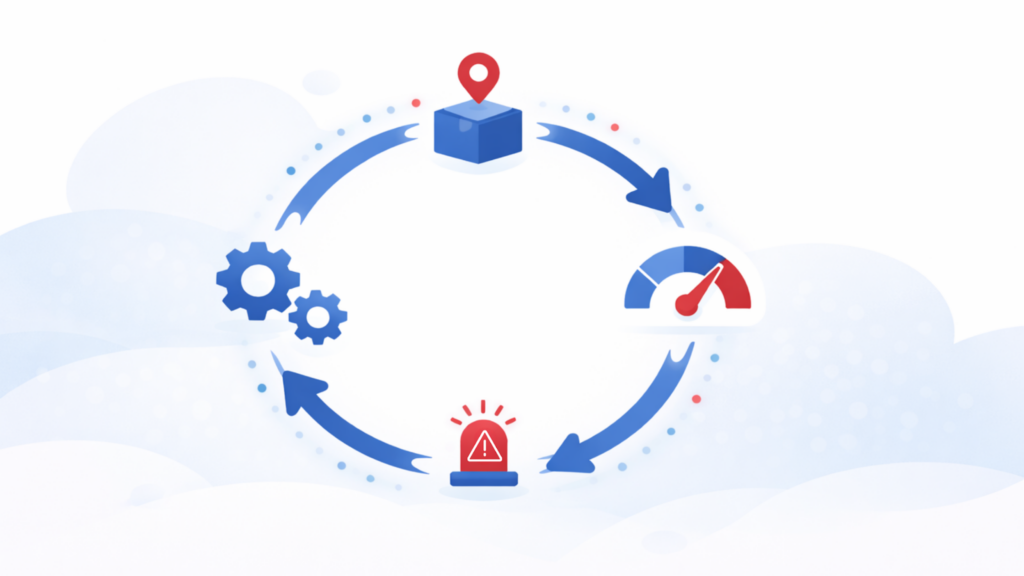
In high-performing last-mile delivery operations, SLAs behave less like static contracts and more like continuous feedback systems.
Instead of applying uniform standards across every delivery, strong SLAs differentiate expectations by delivery type. Same-day orders, scheduled routes, and time-sensitive enterprise or healthcare deliveries are measured differently because they fail differently. Success is defined in operational terms that reflect how work actually happens, not in legal abstractions that only surface after the fact.
These SLAs are built around clearly defined SLIs with explicit numeric SLOs, evaluated on rolling time windows rather than static quarters. Performance is assessed continuously, allowing teams to spot drift early and correct it before it becomes systemic. The focus shifts from defending averages to managing reliability at the delivery-event level.

Benchmarks matter here. Many mature logistics organizations target ≥95% delivery schedule adherence for time-sensitive retail and enterprise routes, a threshold widely referenced in operations and supply-chain performance literature as a baseline for dependable execution. Falling below this level often correlates with rising exception volume, higher reattempt rates, and escalating customer complaints.
Execution capability ultimately determines whether these targets are achievable. Organizations that work with providers capable of real-time tracking, documented handoffs, and continuous performance monitoring tend to resolve issues faster, even when disruptions occur. Visibility enables intervention, and intervention preserves outcomes.
The goal is not perfect performance. In last-mile delivery, perfection is rarely realistic.
“Perfect isn’t the target — being the best is. Because when you can deliver 95% reliability consistently, everybody’s happy. The pursuit of ‘best’ over ‘perfect’ changes everything about how you build, how you plan, and how you recover.”
Sean Spector, CEO
On designing SLAs for reliability
The goal is predictable performance that teams can trust, explain, and improve over time across last-mile delivery operations.
How SLA Benchmarks Differ by Industry
Retail
Retail SLAs sit at the intersection of speed, cost, and customer tolerance.
While customers increasingly expect faster delivery, speed alone does not determine satisfaction or loyalty. Research from McKinsey on what U.S. consumers want from e-commerce deliveries shows that shoppers consistently trade off delivery speed, cost, and convenience, which is why retail SLAs work best when targets are segmented by order type rather than built around a single, blanket same-day promise.
As a result, mature retail organizations segment SLA targets by order type rather than applying a single threshold. Scheduled store replenishment and wholesale routes typically carry stricter expectations, while consumer same-day orders allow slightly more variability, especially in dense urban markets.
In practice, retail SLAs commonly target:
- 95–97% on-time delivery for scheduled replenishment and routed fulfillment
- Moderately lower thresholds for same-day consumer orders, where traffic density and customer availability introduce more volatility
The operational takeaway is not to slow delivery, but to align SLA targets with margin reality and customer willingness to pay.
Healthcare
Healthcare logistics leaves almost no room for interpretation.
In clinical and pharmaceutical supply chains, an SLA is not just a performance standard. It is a compliance mechanism. Timeliness matters, but verification matters more. A delivery that arrives without documented handoff or chain-of-custody evidence is operationally incomplete, regardless of arrival time.
Because of this, healthcare SLAs emphasize verified delivery, documented custody, and audit-ready records alongside strict timing requirements. Many healthcare supply chains target ≥98% verified delivery compliance for clinical and pharmaceutical shipments, reflecting patient safety and regulatory expectations.
This focus on verification over averages is why healthcare delivery networks often adopt stricter proof-of-delivery requirements than retail or enterprise peers, particularly across healthcare logistics operations.
Enterprise Operations
Enterprise SLAs are often designed to protect internal continuity rather than external customer experience alone.
Late or unverified deliveries can halt production lines, delay field service, or cascade into missed internal SLAs between departments. In these environments, reliability and predictability matter more than raw speed.
Enterprise logistics teams commonly structure SLAs around on-time, in-full (OTIF) delivery for critical internal routes, with clearly defined escalation thresholds when performance slips. While exact targets vary by industry and geography, mature enterprise networks frequently aim for ≥96% OTIF on priority routes, paired with rapid escalation when exceptions occur.
The emphasis here is less about maximizing speed and more about ensuring downstream operations can plan with confidence.
Why These Differences Matter
Across retail, healthcare, and enterprise operations, SLA benchmarks are shaped by different risk profiles. What constitutes acceptable performance in one sector may be unacceptable in another.
For supply-chain leaders, the key is not chasing a universal “best” SLA number, but designing benchmarks that reflect operational reality, customer impact, and financial exposure in each delivery context.
Common SLA Mistakes in Last-Mile Delivery
One of the most common mistakes in SLA in logistics is treating SLAs as static documents.
Last-mile networks change constantly. Demand shifts, delivery density evolves, and new service types are added.
When SLAs aren’t revisited, they slowly drift out of alignment with how the operation actually runs. Teams compensate informally, while the SLA continues measuring a version of the network that no longer exists.
Another frequent issue is over-reliance on aggregate performance metrics.
A network can report a 98% on-time rate while failing consistently in specific geographies, delivery windows, or service classes.
These localized failures rarely surface in headline metrics, but they generate a disproportionate share of escalations. Without disaggregated SLIs at the delivery-event level, leadership sees stability while operations absorbs volatility.
Weak exception definitions also undermine accountability.
When SLAs don’t clearly distinguish between a delay, a miss, a failed handoff, or an attempted delivery, ownership becomes negotiable.
Operations teams spend time debating classifications instead of resolving issues. Over time, the SLA stops functioning as a control mechanism and becomes a negotiation tool.
Finally, many organizations underestimate the importance of proof of delivery.
When evidence requirements are vague or inconsistently enforced, disputes multiply and audits slow.
Deliveries may technically occur, but without verifiable documentation they can’t be confidently closed. In regulated or high-value environments, this gap becomes a material operational and compliance risk.
Taken together, these mistakes rarely cause a single catastrophic failure. Instead, they create persistent friction that increases cost, delays recovery, and erodes trust in the SLA itself.
Preparing SLAs for Logistics in 2026
By 2026, SLA in logistics will be judged less by what it promises and more by what it can prove.
As same-day delivery expands and last-mile networks grow denser, expectations around visibility, verification, and response time will continue to rise. SLAs built around static averages and quarterly reviews will struggle to keep pace with real-world execution.
Leaders preparing for this shift are redesigning logistics SLAs as operational systems rather than contractual artifacts. They align SLIs and SLOs with delivery reality, embed verification directly into workflows, and treat exceptions as early warning signals instead of postmortems.
This approach allows teams to surface risk while recovery is still possible, rather than discovering failures after the window to act has closed.
Those who do not make this shift will spend the next several years renegotiating SLAs while quietly absorbing preventable costs, escalations, and customer attrition.
2026 readiness checklist:
Can SLA performance be measured at the delivery-event level, not just as a monthly or quarterly average?
Are SLIs and SLOs clearly defined by delivery type, geography, and time window rather than applied uniformly?
Is proof of delivery verifiable, time-stamped, and audit-ready, not just captured?
Do delivery exceptions trigger alerts early enough to allow recovery, with clear ownership for escalation?
Is SLA performance reviewed on a rolling cadence that reflects current network conditions, not outdated assumptions?
If you answered “no” to any of these questions, your SLA in logistics is likely documenting performance rather than controlling it. That gap tends to show up first as rising exception volume, longer recovery times, and growing internal friction between operations, customer teams, and partners. Left unaddressed, it turns preventable delivery issues into structural cost and reputational risk as same-day and last-mile expectations continue to tighten.
Where to Go Next
If you’re evaluating whether your current SLA in logistics actually supports same-day and last-mile delivery, the next step is understanding how delivery partners operationalize visibility, verification, and escalation in real time. SLAs only work when the systems behind them surface risk early and make recovery possible before a miss becomes visible.
For deeper guidance on how high-performing teams improve consistency at the edge of the supply chain, see Dropoff’s breakdown of last-mile delivery efficiency strategies.
Conclusion
An SLA in logistics is no longer a document reviewed after performance slips. In same-day and last-mile delivery, it functions as a real-time control mechanism that determines whether issues are contained early or exposed at the worst possible moment.
As expectations rise toward 2026, organizations that treat logistics SLAs as enforceable, data-backed systems will be better positioned to scale reliably, control cost, and manage risk at the edge of the supply chain. Those that don’t will continue measuring performance after the fact while absorbing avoidable friction, escalation, and loss of trust when delivery matters most.
Frequently Asked Questions About SLA in Logistics
In logistics, these terms are often used interchangeably, but they serve distinct roles and blurring them weakens enforcement. An SLA (service level agreement) is the formal commitment between parties that defines what level of performance is expected. An SLI (service level indicator) is the specific metric used to measure whether that commitment is being met. An SLO (service level objective) is the numeric target applied to that metric.
The distinction matters most in last-mile delivery, where outcomes hinge on execution at the delivery-event level. For example, “on-time delivery” is not an SLA by itself. It becomes enforceable only when paired with a measurable indicator, such as delivery within a defined window, and a clear objective, such as 95 percent compliance over a rolling period. Without this structure, SLAs remain contractual language rather than operational controls.
In same-day and last-mile delivery, SLAs are enforced through visibility and timing, not post hoc reporting. Enforcement depends on whether performance can be measured as each delivery unfolds, rather than reconstructed after the fact.
Effective enforcement relies on event-level tracking, real-time status updates, and clearly defined escalation paths when something deviates from plan. If a delivery is trending late, the system must surface that risk early enough for intervention. When SLAs are enforced only through end-of-day or end-of-month reports, failures are documented rather than prevented. In practice, enforceable SLAs are those that trigger action while recovery is still possible.
The most effective last-mile SLAs focus on a small number of metrics that reflect reliability, not just speed. Common examples include delivery window adherence, verified proof of delivery, and exception response time.
What matters is not the number of metrics, but how precisely they are defined and applied. Metrics should be measured at the stop level and segmented by delivery type rather than averaged across the network. A narrow, well-defined set of SLIs tied to clear SLOs provides more operational signal than a broad scorecard that masks localized failures. In last-mile delivery, fewer metrics with sharper definitions tend to drive better outcomes.
SLA requirements vary significantly by industry because the consequences of failure differ. In retail, SLAs often balance speed against margin, with segmented targets for replenishment versus consumer orders. Reliability matters, but some variability is tolerated depending on cost sensitivity.
Healthcare logistics places far greater emphasis on verification and chain of custody. A delivery that arrives without documented handoff is considered incomplete, regardless of timing. Enterprise operations often prioritize predictability and continuity, where missed or unverified deliveries can disrupt internal workflows even if customers are unaffected. Across industries, SLA design reflects risk exposure more than theoretical performance ideals.
When SLAs are missed repeatedly, the issue is rarely isolated execution. Persistent misses usually indicate a mismatch between SLA design and operational reality. Over time, this leads to higher exception volume, longer recovery cycles, and increased internal friction between operations, customer teams, and partners.
Financially, consistent SLA failure drives reattempt costs, customer attrition, and in regulated environments, compliance risk. Trust erodes as stakeholders stop treating the SLA as a reliable signal. At that point, the SLA no longer guides behavior and instead becomes a source of negotiation and escalation, which increases cost without improving performance.
To support same-day delivery, SLAs must evolve from static benchmarks to adaptive operating frameworks. This means defining SLIs and SLOs by delivery type, geography, and time window, rather than applying uniform targets across the network.
Future-ready SLAs are reviewed on rolling cadences, incorporate real-time visibility, and treat exceptions as early warning signals instead of postmortems. As delivery windows tighten, the ability to surface risk early and intervene quickly becomes more important than hitting perfect averages. Companies that redesign SLAs around this reality are better positioned to scale same-day delivery without absorbing avoidable cost and disruption.