Types of Last-Mile Delivery and How They Impact Speed & Cost
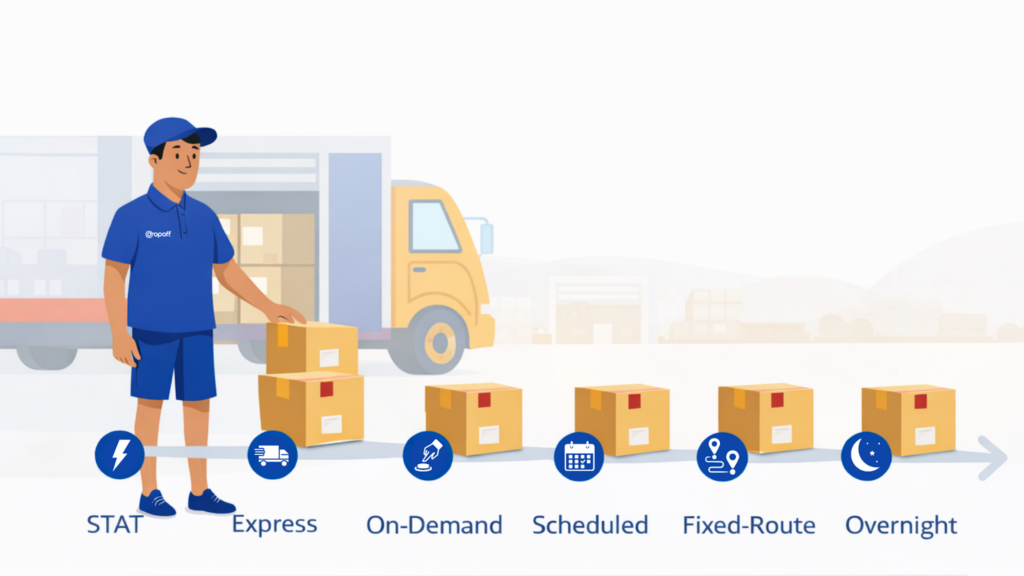
The phrase “last-mile delivery” is often treated as a single function. In reality, it refers to a range of delivery models, each with different implications for speed, cost, risk, and operational control across retail, healthcare, and enterprise supply chains.
For logistics and supply-chain leaders, this distinction matters more than ever. The wrong delivery type doesn’t just increase transportation spend. It introduces operational fragility, forcing teams to compensate downstream through escalation, manual coordination, and service recovery—especially as last-mile delivery costs can account for more than half of total shipping spend.
Understanding the types of last mile delivery is no longer about terminology. It’s about system design. Leaders who align delivery methods to urgency, volume, and consequence build networks that move fast when required, stay economical when possible, and remain reliable under pressure—an approach consistent with network design principles that balance cost, service levels, and reliability.
What Is Last-Mile Delivery?
Last-mile delivery refers to the final leg of a shipment’s journey, moving goods from a distribution point to their end destination. That destination may be a customer’s home, a retail location, a healthcare facility, or another business site—each with distinct service requirements and constraints, as commonly understood in logistics and supply-chain operations.
What makes the last mile uniquely challenging is not distance, but variability. Routes are short, yet outcomes depend on human coordination, precise timing, access constraints, and confirmation that the delivery was completed correctly. A missed handoff, a locked door, or an incomplete proof of delivery can derail the entire process.
Because of that complexity, last-mile delivery is not a single service. It is a collection of delivery types and methods, each designed to manage different tradeoffs between speed, efficiency, and risk. How those methods are selected and combined determines whether a delivery network scales smoothly or becomes fragile under pressure.
Why Delivery Type Choice Has Become a Strategic Decision
Last-mile delivery is widely recognized as the most complex and expensive segment of logistics operations. Costs are driven less by distance and more by structural inefficiencies such as labor intensity, low drop density, and failed delivery attempts, which is why last-mile delivery can account for more than 50% of total shipping costs.
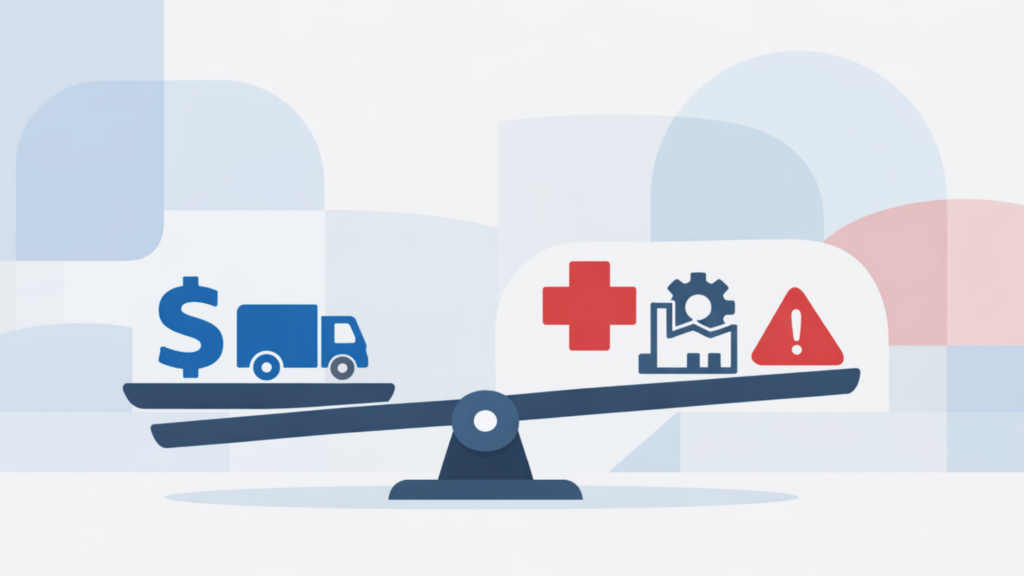
That complexity has intensified as same-day delivery expectations have moved beyond retail into healthcare and enterprise operations. In these environments, a late delivery doesn’t just inconvenience a customer. It can disrupt clinical workflows, delay procedures, or stall business-critical processes, increasing downstream risk rather than simply eroding satisfaction.
At the same time, expectations around speed have matured. Supply-chain leaders are increasingly prioritizing reliability, predictability, and resilience over raw velocity, aligning delivery decisions with broader supply chain management principles focused on risk, cost, and service-level balance.
This reframes the leadership challenge. The question is no longer “How fast can we deliver?” but “Which delivery type aligns with the real consequence of being late?” When delivery models are selected based on impact rather than habit, last-mile performance shifts from a reactive cost center to a deliberate strategic lever.
How Last-Mile Delivery Types and Methods Actually Differ
Most discussions of last-mile delivery flatten meaningful distinctions. They catalog delivery options without explaining how those options behave once they encounter real-world constraints like labor availability, routing complexity, and service-level commitments.
In practice, last-mile delivery models diverge along a small set of operational forces that determine outcomes. The delivery time window sets urgency and limits planning flexibility. The dispatch model determines whether capacity can be shared across multiple stops or must remain dedicated to a single shipment. Cost structure follows directly from those decisions, increasing as inefficiency is introduced to achieve speed. Risk profile defines the consequence of failure, whether that failure is a missed delivery window, a broken chain of custody, or an unverified handoff.
These forces directly shape route density, vehicle utilization, and the number of deliveries completed per hour—core drivers of last-mile efficiency and cost that logistics leaders monitor when optimizing networks and controlling spend, particularly in same-day and on-demand environments. This relationship between planning, density, and performance is explored further in last-mile delivery efficiency strategies.
Viewed through this lens, the different types of delivery services stop looking interchangeable. They become purpose-built tools, each designed to solve a specific operational problem. When those tools are misapplied—using dedicated dispatch where shared capacity would suffice, or compressing delivery windows without consequence awareness—cost and risk accumulate quietly. When they are aligned correctly, last-mile delivery becomes more predictable, scalable, and far easier to govern.
Immediate and Urgent Delivery Types: When Delay Has Consequences
STAT delivery exists because some delays carry consequences that extend far beyond inconvenience. In certain environments, minutes matter, and the cost of being late is measured not in dissatisfaction, but in clinical risk or operational downtime.
Operationally, STAT delivery triggers immediate dispatch. A courier is assigned to a single shipment and routed directly to its destination, with no opportunity for batching, sequencing, or optimization. This makes STAT delivery the fastest form of last-mile delivery and, by design, the most expensive. Speed is achieved by removing every efficiency lever that normally keeps costs in check.
In healthcare, STAT delivery is commonly used for specimens, pharmaceuticals, blood products, or equipment required to support diagnosis and treatment. Regulatory guidance around specimen handling and timeliness underscores why delays can compromise outcomes, particularly when temperature control, custody, or viability are at stake, as reflected in clinical laboratory standards for specimen transport and handling
https://www.cdc.gov/labquality/specimen-collection.html
In enterprise environments, STAT delivery appears under different pressures. Critical parts failures, system outages, or halted production lines can make downtime far more expensive than expedited transportation. In those moments, STAT delivery functions as an insurance policy, absorbing cost to prevent larger losses.
What good looks like here is restraint. STAT delivery performs best when it is explicitly protected as an exception, not normalized as a default. When used routinely, it often signals upstream breakdowns in planning, inventory positioning, or decision governance rather than genuine urgency.
Because the margin for error is narrow, organizations that rely on STAT delivery typically require rigorous controls. These include documented chain of custody, real-time tracking, confirmation of delivery, and defined escalation paths if something deviates. These safeguards do not reduce cost, but they prevent additional risk from compounding an already high-stakes situation.
For teams managing regulated or clinically sensitive shipments, STAT delivery is often supported through specialized programs such as healthcare courier delivery solutions.
Express Delivery: Speed With Boundaries
Express delivery sits in a narrower band of urgency. Shipments still move within hours, but unlike STAT delivery, they operate inside a defined delivery window rather than requiring immediate dispatch. That boundary is what makes express delivery operationally distinct.
From an execution standpoint, express delivery introduces just enough planning flexibility to reduce cost without sacrificing responsiveness. Couriers may still run largely dedicated routes, but limited sequencing and scheduling become possible. Compared to STAT delivery, this allows modest efficiency gains while preserving speed, particularly when delivery windows are measured in hours rather than minutes.
Express delivery is commonly used for same-day healthcare transfers that are time-sensitive but not life-critical, such as routine lab samples or medical supplies needed before a scheduled procedure. In retail and enterprise environments, it supports shipments where delay would create customer dissatisfaction or operational disruption, but not irreversible harm.
What good looks like here is clarity and governance. Teams that define express delivery thresholds explicitly tend to use it with discipline. Teams that don’t often default to express because it feels safer than renegotiating expectations or explaining delay. Over time, that behavior erodes the very cost advantage express delivery is meant to provide.
This is why express delivery works best as a controlled escalation path rather than a baseline service. High-performing organizations anchor routine same-day volume in planned models and reserve express for genuine exceptions, pairing it with structured programs like same-day delivery services.
The value of express delivery lies in meeting committed delivery windows consistently, not compressing them endlessly. Recent analysis of real transit-time data shows that reliability within defined timeframes is often a stronger indicator of performance than absolute speed, reinforcing express delivery’s role as a bounded, predictable option rather than an always-on speed play, as shown in transit-time performance across fastest shipping routes.
Flexible same-day delivery exists to absorb uncertainty. It is where most last-mile networks feel efficient on the surface, but where cost and complexity can quietly accumulate if left unmanaged.
On-Demand Same-Day Delivery: Flexibility at a Cost
On-demand delivery is designed for variability. It allows teams to request same-day delivery as needs arise, without pre-scheduling routes or committing volume. That flexibility makes it attractive in retail environments with unpredictable order flow and in enterprise operations supporting field teams, service calls, or ad-hoc transfers.
The tradeoff is efficiency. Because requests are reactive, route density tends to be lower and planning windows shorter. Couriers are dispatched to satisfy immediate demand rather than optimized routes, which limits stop consolidation and increases cost per delivery. Over time, frequent on-demand usage often begins to resemble a series of mini-express deliveries, even if none of them are individually urgent.
What good looks like is selective use. On-demand delivery performs best when it absorbs volatility at the edges of the network, not when it replaces structured planning. Leaders who examine on-demand volume patterns often discover that a meaningful share of this demand is actually repeatable, just undocumented. Migrating that volume into planned delivery models is one of the fastest ways to regain cost control.
Organizations that rely on on-demand courier delivery most effectively treat it as a release valve, not the backbone of their last-mile strategy. The value lies in responsiveness, not permanence.
Scheduled Same-Day Delivery: Where Cost Discipline Begins
Scheduled same-day delivery introduces intention into last-mile operations without abandoning speed. Pickups and drop-offs are booked in advance, sometimes only hours ahead, but with enough notice to support route optimization and predictable labor allocation.
That planning window changes the economics. Stop density increases, idle time decreases, and per-delivery cost improves without sacrificing same-day service. This model is particularly effective in healthcare networks with repeatable clinic-to-lab transfers, retail replenishment cycles, and enterprise distribution between known locations.
What good looks like here is reliability. When schedules are honored and exceptions are clearly defined, scheduled delivery becomes the quiet workhorse of last-mile logistics. It handles the bulk of same-day volume consistently, leaving urgent models free to serve true exceptions rather than routine demand.
Leaders who invest in scheduled delivery often unlock further gains by pairing it with broader last-mile delivery efficiency strategies where planning, density, and execution are treated as interconnected levers rather than isolated decisions.
Industry data consistently shows that route planning and delivery density are among the strongest drivers of last-mile cost and performance, reinforcing why even modest scheduling discipline can materially improve outcomes, especially as last-mile delivery now accounts for more than half of total shipping costs in many networks.
Cost-Optimized Delivery Types: Predictability Over Speed
Cost-optimized delivery models are built around one premise: not every shipment needs to move as fast as possible. When urgency is calibrated honestly, predictability becomes the most powerful lever for controlling last-mile cost without sacrificing service.
Fixed-Route Delivery: Predictability as a Cost Strategy
Fixed-route delivery represents the most operationally mature form of last-mile service. Routes are predefined. Stops recur at the same locations and times. Over time, this creates high route density, consistent driver utilization, and stable performance that can be measured and improved incrementally.
From a cost perspective, fixed routes deliver the lowest cost per stop because capacity is planned and fully utilized. From a risk perspective, they reduce variability, making failures easier to isolate and correct. Performance improves not through speed, but through repetition and control.
The limitation is flexibility. Fixed routes are not designed for spikes or urgent exceptions. When organizations attempt to force urgency into a fixed-route network, they erode the very efficiencies they built, introducing ad-hoc deviations that undermine density and predictability.
What good looks like is separation of concerns. Fixed routes handle the predictable core of demand. Other delivery types absorb volatility. Many organizations formalize this approach through fixed-route delivery services.
Overnight Delivery: The Overlooked Middle Ground
Overnight courier delivery often receives less attention than it deserves, despite being one of the most effective tools for balancing speed and cost.
By shifting delivery to the next day, organizations regain planning flexibility without defaulting to multi-day parcel shipping. Urgency premiums fall, routing options expand, and operational timelines remain intact. In many cases, overnight delivery satisfies the real requirement: arriving before a scheduled event, not as soon as possible.
This model is particularly effective for healthcare and enterprise shipments that must be available at the start of a shift, procedure, or business day, but do not require same-day transit. It preserves reliability while avoiding the cost structure of express or STAT delivery.
What good looks like is reclassification. Leaders who revisit urgency assumptions often find that overnight delivery can replace a meaningful share of express volume without operational harm. When used intentionally, it becomes a pressure-release valve for same-day networks rather than a downgrade in service.
Organizations that use overnight courier services strategically tend to see lower exception rates and more predictable cost curves.
Long-Haul Courier Delivery: Control Over Distance
Long-haul courier delivery extends last-mile principles across greater distances, prioritizing accountability and visibility over pure linehaul efficiency.
Unlike traditional freight networks, long-haul courier services emphasize end-to-end tracking, defined custody, and direct responsibility across the journey. This makes them suitable for sensitive healthcare shipments and high-value enterprise transfers where loss, delay, or misrouting carries outsized risk.
Speed varies by distance, but velocity is not the defining feature. Control is. Choosing long-haul courier delivery is an explicit decision to favor ownership, transparency, and reliability over the lowest possible unit cost.
What good looks like is alignment. Organizations deploy long-haul courier delivery when the cost of uncertainty exceeds the premium of direct control, often formalized through long-haul delivery services.
How Different Types of Last-Mile Delivery Affect Cost
Delivery cost is not driven by distance alone. It is driven by urgency, planning flexibility, and how efficiently capacity can be shared across stops.
Dedicated dispatch, narrow delivery windows, and low stop density all increase cost by design. Scheduled routes, predictable volume, and shared capacity reduce it. When urgency is over-applied, inefficiency compounds quietly, often masked as “service quality” rather than recognized as a structural design issue.
This is why cost overruns are frequently traced back to delivery-type misuse rather than carrier pricing. Networks that rely too heavily on urgent models pay for speed they do not always need, while underutilizing planning levers that could stabilize performance.
Leaders who manage last-mile cost effectively treat delivery type selection as a design decision, not an afterthought. They align urgency with consequence, reserve premium models for true exceptions, and allow predictable delivery types to do what they do best: make the network cheaper, steadier, and easier to govern.
Common Last-Mile Delivery Use Cases by Industry
While the underlying delivery types are often the same, the way they are applied varies significantly by industry because the consequences of delay differ.
Healthcare organizations prioritize custody, compliance, and timeliness above all else. Networks often layer STAT, express, and scheduled delivery together to balance urgency with control, particularly for specimens, pharmaceuticals, and equipment where chain of custody and delivery confirmation are non-negotiable. These requirements frequently shape the structure of healthcare courier delivery solutions.
Retail operations operate under a different pressure set. Customer expectations and demand variability require responsiveness, but margins demand discipline. Many retailers rely on scheduled and fixed-route delivery to stabilize recurring volume, reserving on-demand delivery for true demand spikes rather than daily fulfillment. This balance is critical to maintaining service levels without eroding unit economics across same-day delivery services.
Enterprise environments tend to emphasize predictability and internal coordination. Inter-facility transfers, parts movement, and document delivery benefit from repeatable schedules and clear escalation paths. Urgent delivery is used sparingly, typically when downtime or operational disruption outweighs transportation cost. The delivery types may be similar, but the decision logic is shaped by operational risk rather than customer experience.
Common Mistakes Leaders Make With Last-Mile Delivery Types
The most frequent failure in last-mile delivery is not choosing the wrong provider. It is choosing the wrong delivery type for the job.
One common mistake is collapsing urgency categories. When everything is labeled “urgent,” nothing truly is. Express and STAT delivery become defaults, masking upstream planning failures and inflating spend without improving outcomes.
Another is failing to revisit assumptions. Delivery models adopted during periods of volatility or disruption often persist long after conditions normalize. Without regular review, premium services quietly turn into habits, locking in unnecessary cost.
A third mistake is ignoring operational signals. Rising exception rates, increased manual coordination, and inconsistent documentation are often symptoms of delivery-type mismatch rather than execution failure. Treating them as performance issues rather than design flaws delays correction.
What good looks like is governance. High-performing teams define clear criteria for each delivery type, review usage patterns regularly, and adjust models as demand stabilizes. They manage last-mile delivery as a system, not a collection of one-off decisions.
How High-Performing Teams Use Multiple Delivery Types Together
No single delivery model supports every operational need.
Resilient organizations design layered last-mile systems. Fixed routes handle predictable, repeatable volume. Scheduled delivery absorbs planned variability. On-demand delivery provides flexibility at the edges. Express and STAT delivery protect against true exceptions where delay carries real consequence.
This portfolio approach reduces cost leakage while preserving responsiveness. It also simplifies escalation. Teams know which lever to pull and when, reducing debate, manual intervention, and decision latency during high-pressure moments.
Organizations that structure delivery this way often see steadier performance across their last-mile delivery efficiency strategies because urgency is treated as a controlled variable rather than an emotional reaction.
Measuring Success Beyond Speed
Speed alone is an incomplete metric. Faster delivery means little if it comes at the expense of reliability, documentation, or predictability.
Industry benchmarking shows that consistency, first-attempt delivery success, and exception resolution time are often more meaningful indicators of performance than raw transit speed. Analysis of real-world transit data demonstrates that meeting committed delivery windows reliably is a stronger signal of network health than shaving incremental minutes off delivery times.
Leaders who track performance by delivery type gain visibility into where cost and risk accumulate. Those who don’t often chase symptoms—missed deliveries, escalations, rising spend—without addressing the structural causes underneath.
How to Choose the Right Types of Last-Mile Delivery
Understanding the types of last mile delivery is no longer a tactical concern. It’s a leadership responsibility tied directly to cost control, service reliability, and operational resilience.
Speed should be treated as a capability, not a reflex. When delivery types are aligned deliberately to urgency, volume, and consequence, last-mile networks become more predictable and far easier to govern. When they aren’t, cost escalates quietly and risk compounds out of sight.
Organizations that succeed in last-mile logistics are not the fastest everywhere. They are precise where it matters and disciplined everywhere else, designing delivery systems that scale under pressure rather than reacting to it.
Pressure-test your last-mile delivery design.
If you’re evaluating how STAT, express, on-demand, scheduled, and route-based delivery fit together across your operation, a short conversation can help clarify where urgency, cost, and risk may be misaligned. You can speak with a delivery expert.
Frequently Asked Questions About Last-Mile Delivery Types
The main types of last-mile delivery include STAT delivery, express delivery, on-demand same-day delivery, scheduled same-day delivery, fixed-route delivery, overnight delivery, and long-haul courier delivery. Each type is designed to balance speed, cost, and risk differently based on urgency, predictability, and the consequence of delay. The key difference is not distance, but how much planning and shared capacity each model allows.
Last-mile delivery cost is driven primarily by urgency and planning constraints, not mileage. Delivery types that require immediate dispatch, narrow time windows, or dedicated couriers are inherently more expensive because they limit efficiency and route density. Models that allow scheduling, shared capacity, and predictable volume reduce cost by improving utilization and lowering cost per stop.
STAT delivery should be used only when delay creates material clinical or operational risk, such as time-sensitive medical specimens or critical equipment failures. Express delivery is better suited for shipments that are urgent but not life-critical and can be completed within a defined time window. Overusing STAT delivery often signals upstream planning gaps rather than true urgency.
On-demand same-day delivery is reactive and designed to absorb variability when needs arise unexpectedly. Scheduled same-day delivery introduces planning, even if only hours in advance, enabling route optimization and lower unit costs while still meeting same-day requirements. High-performing networks use on-demand delivery for exceptions and scheduled delivery for repeatable demand.
A common mistake is collapsing all urgency into a single category, causing express and STAT delivery to become defaults. Another is failing to revisit delivery models after periods of volatility, allowing premium services to turn into habits. Many organizations also misinterpret rising exceptions or manual workarounds as execution problems, when they are often signs of delivery-type mismatch.
Last-mile performance should be measured by reliability, not speed alone. Key indicators include on-time delivery within the promised window, first-attempt delivery success, exception frequency, and resolution time. Tracking these metrics by delivery type helps leaders identify where cost and risk accumulate and adjust delivery design accordingly.