Specialty Pharmacy Delivery Challenges: Where Direct-to-Patient Delivery Actually Breaks
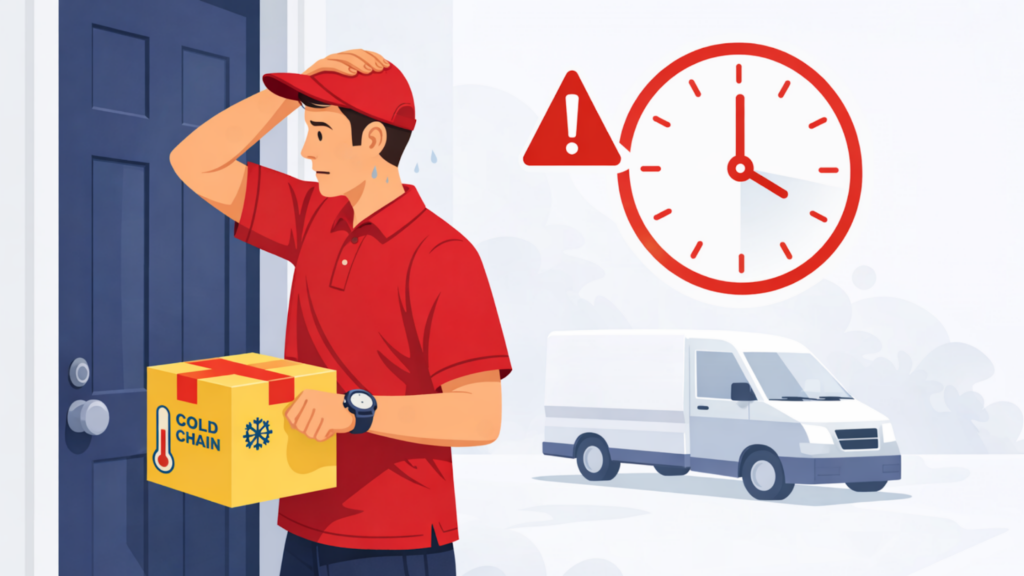
A refrigerated specialty medication is out for delivery.
Packed under cold chain logistics in healthcare delivery protocols.
Scheduled for direct-to-patient specialty pharmacy delivery.
Signature required.
In many cases, that single shipment represents $5,000 to $50,000+ in therapy. In some specialty categories, annual treatment costs exceed $100,000 per patient, which turns each shipment into a high-risk clinical and financial event.
The driver arrives. No answer. The route moves on. The next attempt shifts to tomorrow.
From a tracking standpoint, the shipment is still “on time.”
From an operational standpoint, the system has already broken.
Because that first delivery attempt was the only moment where everything aligned:
- patient availability
- temperature control
- route timing
- chain of custody
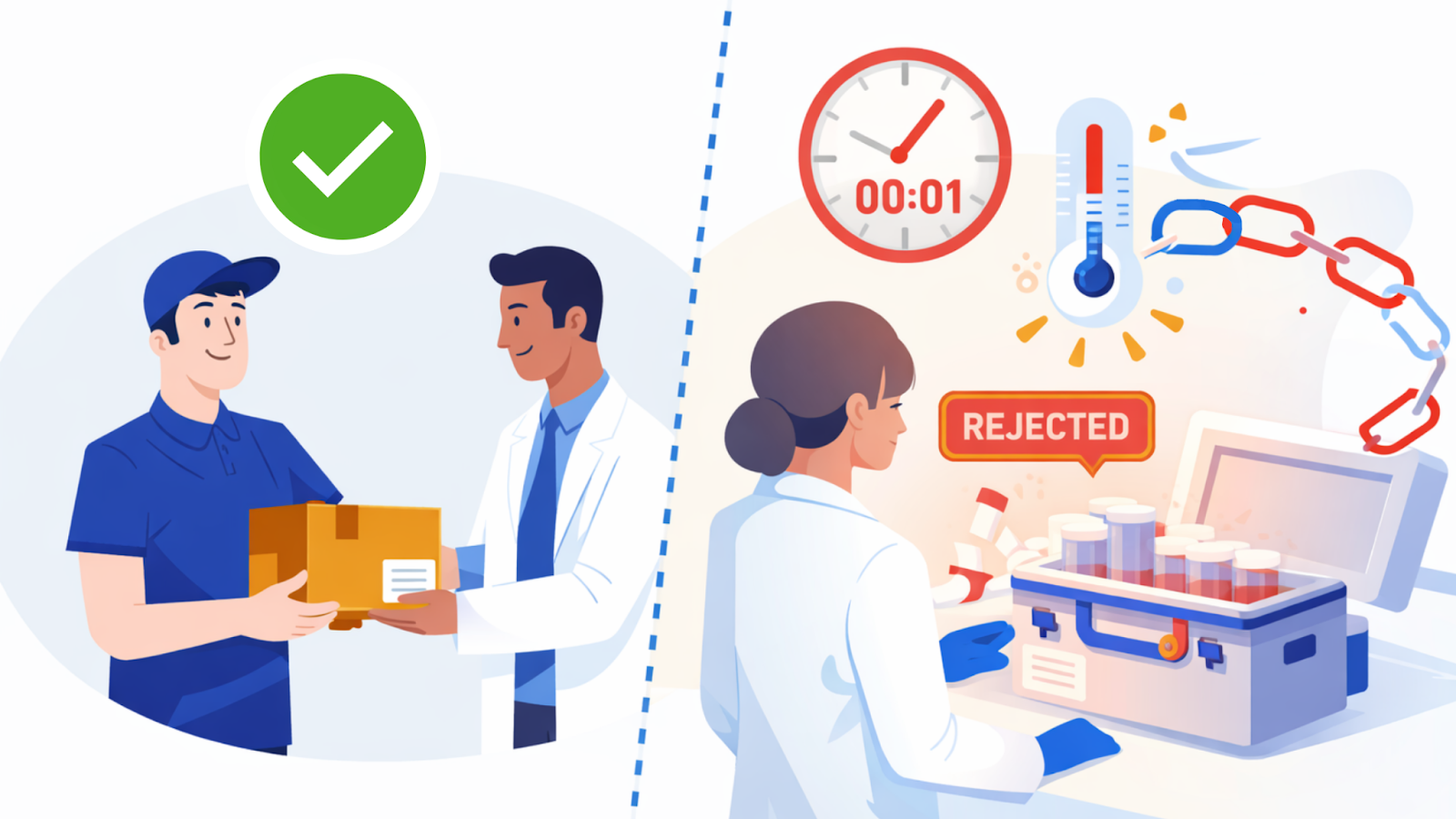
Miss it, and the shipment doesn’t just get delayed. It falls out of a controlled system and into exception handling, where delivery reliability, cold chain integrity, and therapy timing begin to drift.
According to industry estimates, including data from Dickson, up to 25% of temperature-sensitive pharmaceuticals experience temperature excursions during distribution.
That risk compounds in last-mile healthcare delivery. Most content on specialty pharmacy delivery challenges focuses on shipping performance. This piece focuses on where the system actually breaks.
The Real Problem with Direct-to-Patient Specialty Pharmacy Delivery
Most conversations about direct-to-patient logistics start in the wrong place.
Transit time. Shipping cost. Carrier performance.
They’re easy to measure. They’re also the least predictive of whether delivery actually works.
Because by the time a shipment is in motion, the outcome is already heavily influenced.
A more typical day:
10:12am — prescription verified, prior auth cleared late
1:40pm — patient called once, voicemail left
3:55pm — cutoff approaching, shipment released
No confirmed availability.
No validated delivery window.
But the shipment goes out anyway.
Internally, this looks like execution:
- turnaround time protected
- shipment released on schedule
- delivery in progress
Operationally, it’s a commitment to assumptions the system can’t correct later.
Where the System Actually Breaks
Specialty pharmacy delivery doesn’t fail in one place. It fails where alignment has to hold across the system:
- Coordination before shipment
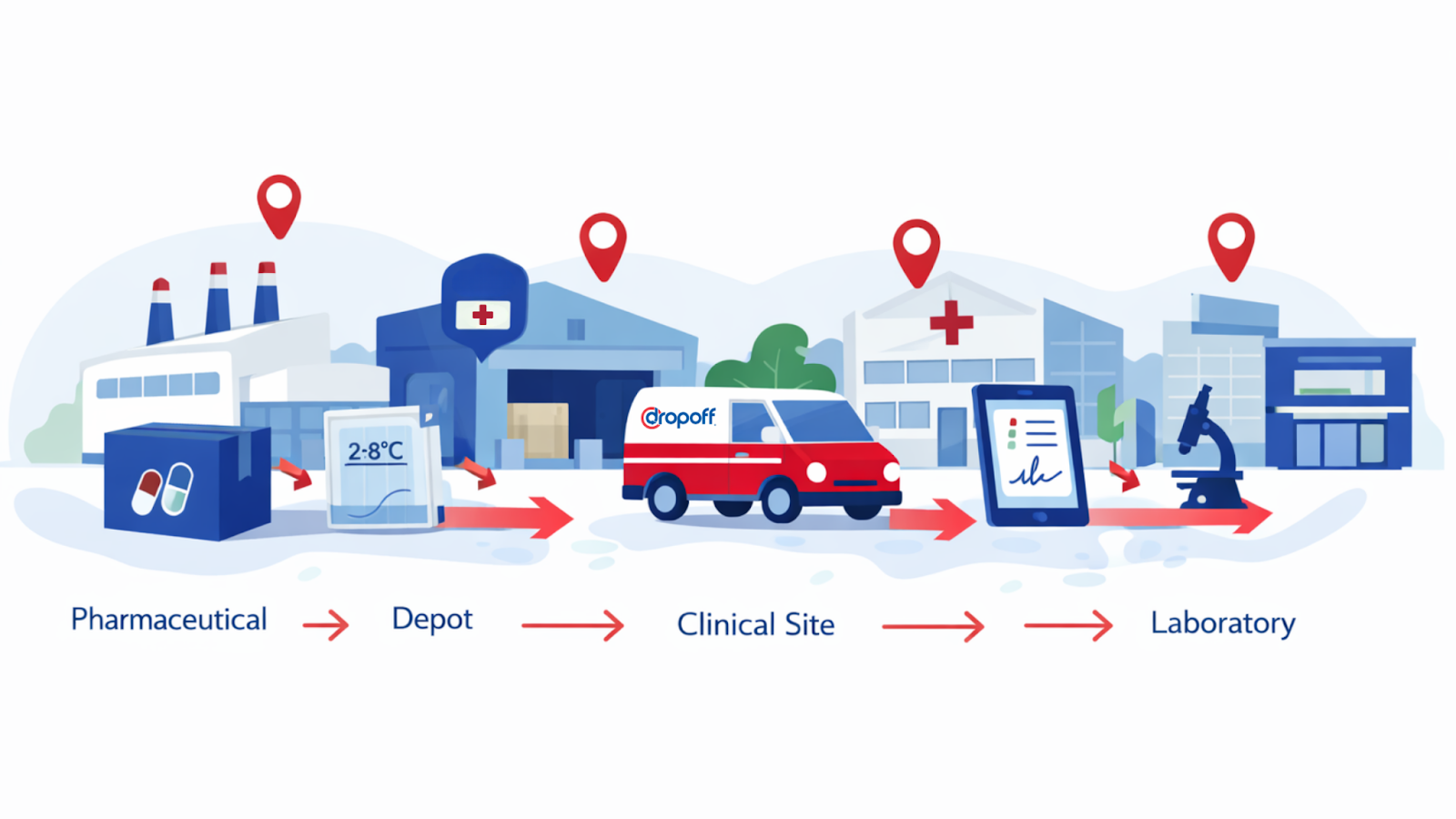
- Chain of custody during handoffs
- Patient availability at delivery
- Temperature control after delivery
Failures rarely stay isolated. They move across these points.
Data from Surescripts shows that missing information and prior authorization delays are among the most common sources of friction in specialty medication workflows. Those issues don’t stop upstream. They propagate into delivery.
Delivery isn’t a step. It’s the outcome of everything before it.
1. Coordination Failures Before Shipment
Late-day clearance. Cutoff pressure. A single unanswered call.
Someone says they spoke to the patient 24–36 hours earlier.
“Should be fine.”
The shipment is released.
Nothing about this moment looks like a failure.
That’s exactly why it matters.
What’s actually happening is simpler and more dangerous: availability is assumed instead of confirmed, timing is guessed instead of aligned, and success depends on a first attempt the system does not fully control.
Studies from Surescripts and CoverMyMeds consistently show that missing information and breakdowns in patient communication are leading contributors to delays in specialty medication workflows.
This is where teams realize something uncomfortable: They don’t actually control whether the delivery will work.
2. Chain of Custody Breakdowns
This is where the problem shifts from operational to clinical and regulatory exposure.
A shipment leaves the pharmacy in a known state. Then it moves.
Scanned. Logged. Timestamped.
It looks controlled. Until a patient says:
“It felt warm.”
Under good distribution practice guidelines like USP <1079> for pharmaceutical storage and transport, maintaining documented control over handling conditions isn’t optional—it’s expected.
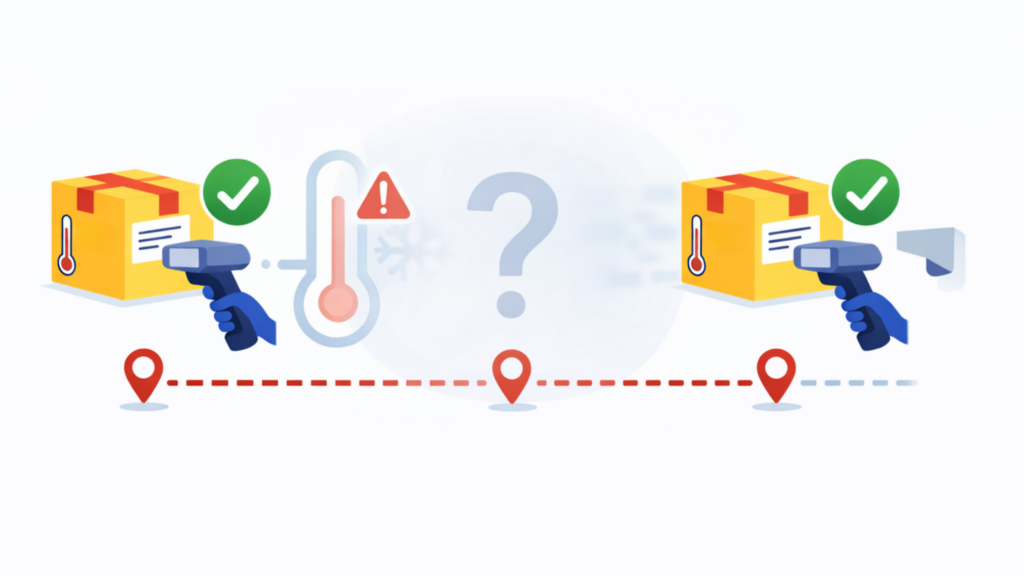
Most systems can answer where a shipment was scanned, but that’s very different from true last-mile delivery tracking.
It does not tell you how long the package sat between scans, what temperature conditions were maintained during that time, or who is accountable for the gap.
Example:
4:10pm — scanned
5:35pm — out for delivery
That 85-minute window is operationally invisible.
Industry patterns show many cold chain failures are only identified after delivery, when product integrity is questioned.
At that point, the system shifts:
- pharmacist review
- quarantine
- replacement
Not because failure is confirmed. Because it can’t be ruled out.This is where delivery risk becomes audit risk.
3. Failed Delivery Attempts in Specialty Pharmacy
A missed delivery isn’t just a delay. It’s a structural break.
In most networks, that break triggers a full operational reset. The shipment is pulled out of its original route logic and reprocessed: re-entered into dispatch queues, reassigned to a new driver or route, and exposed to additional dwell time between attempts.
In many cases, these failures aren’t just routing issues. They’re labor model issues.
As organizations push to reduce delivery costs, more shipments are routed through gig-style driver networks that were never designed for specialty pharmacy requirements. The tradeoff shows up at the worst possible moment. Drivers may be unfamiliar with handling protocols, deliveries land at the wrong location or with the wrong recipient, and timing slips on shipments that depend on a coordinated handoff.
What looks like a simple delivery miss is often a breakdown in capability at the point where precision matters most.
What began as a controlled, single-path delivery becomes a multi-step recovery process. The route was optimized the night before. Every stop fit a sequence. Now the shipment is operating outside that plan: a new route, new timing, a new exposure window.
Meanwhile, the product continues moving through time.
A single failed delivery can trigger additional routing cost, temperature uncertainty, and delayed therapy initiation.
First-attempt delivery success is one of the strongest drivers of cost and reliability in last-mile healthcare logistics. While exact rates vary by network, industry data consistently shows failure rates in the 10–20% range, with higher risk in deliveries requiring signatures or coordinated handoff. In specialty pharmacy, those failures carry significantly higher downstream costs.
From the outside, it looks routine. Inside the operation, alignment is gone.

4. Temperature Control Risks After Delivery
Delivery is treated as the endpoint. It isn’t. It’s where system visibility drops off.
The package is delivered. Status closed.
But:
- it may sit outside
- it may be opened later
- it may be stored improperly
Guidance from the CDC and USP emphasizes that temperature control must be maintained until point of use. This is the part of cold chain pharmaceutical delivery most systems don’t see—but are still responsible for.
If something goes wrong, it won’t show up in tracking. It shows up later as uncertainty, as a question, or as a replacement.
Common Specialty Pharmacy Delivery Failure Chains
Most failures don’t originate in one moment. They compound. By the time someone notices the problem, the system is usually dealing with consequences, not causes.
| Failure Trigger | What Happens Next | Outcome |
| Missed delivery | Loss of controlled conditions | Replacement shipment |
| Visibility gap | Delayed response | Escalation + patient impact |
| Temperature alert | Manual review + reshipment | Operational cost + delay |
Across systems, the pattern is consistent: The cost of specialty pharmacy delivery is driven by exception handling—not baseline shipping.
Why “On-Time Delivery” Is the Wrong Metric
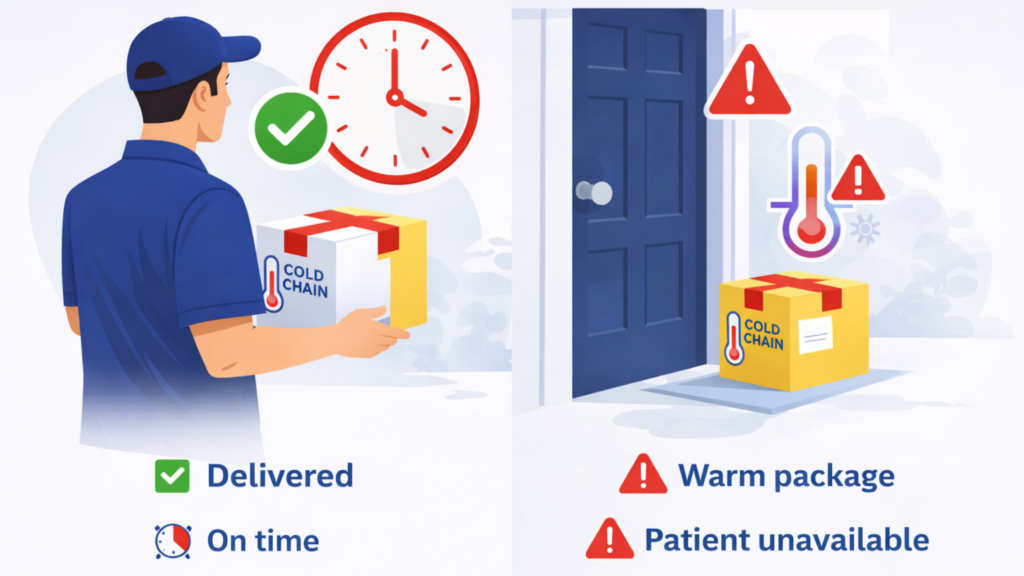
A shipment can be delivered on time, scanned correctly, marked complete …and still fail.
Because “on time” measures movement. Not outcome.
It doesn’t capture:
- product condition
- patient readiness
- usability at handoff
A shipment can complete perfectly and still fail clinically.
Tradeoffs in Specialty Pharmacy Logistics
Every delivery model optimizes for something.
A same-day shipment released without confirmed patient availability may reduce transit time—but increases the probability of a failed first attempt.
That single tradeoff introduces re-routing, extended exposure, and potential replacement.
Lower-cost delivery models often increase the number of handoffs, variability in handling, and gaps in accountability.
Higher-control models reduce variability—but require tighter coordination and visibility.
Patient experience adds another layer: Convenience pushes toward flexibility. Compliance requires control.
Most delivery networks are built for parcel efficiency: multiple handoffs, standardized routing, and scan-based visibility.
Those systems work well when delivery success is defined as movement. They break down when success depends on:
- controlled handoff
- coordinated timing
- verifiable conditions
That’s where pharmacy-oriented delivery models begin to diverge.
What Improves Specialty Pharmacy Delivery Reliability
Improving specialty pharmacy delivery reliability isn’t about adopting best practices in theory. It’s about choosing a delivery model that can answer very specific operational questions before something goes wrong.
High-performing healthcare delivery models tend to share three characteristics:
1. Reduced Custody Transitions
High-performing delivery models built for pharmacies tend to reduce handoffs, improve visibility, and tighten control at the point of handoff.
What to look for:
Can your delivery partner clearly map every custody transfer between pharmacy and patient—and minimize how many exist?
2. Real-Time Operational Visibility
Not just scan history. Effective systems can answer: where the shipment is, what condition it’s in, whether intervention is needed now.
What to look for:
Can you see issues as they develop, or only after a delivery exception is created?
3. Upstream Coordination Alignment
Delivery works when:
- patient availability is confirmed
- timing reflects therapy requirements
- assumptions are minimized before release
What to look for:
Does your process confirm delivery readiness before shipment—or rely on best-effort coordination?
4. Systems Designed for Exceptions
Reliable systems assume failures will occur and delays will happen.
The differentiator is detection speed, response clarity, and recovery efficiency.
Models that combine fewer handoffs, real-time visibility, and direct delivery control consistently outperform fragmented networks.What to look for:
When something goes wrong, is the response standardized and fast—or manual and reactive?
How to Evaluate Specialty Pharmacy Delivery Reliability
In practice, many of these gaps show up as the same signs your current medical courier is lacking.
Most delivery models look reliable until you ask the wrong question.
Not: “Was it delivered on time?”
Ask:
- How many custody handoffs occur between pharmacy and patient?
- Can you verify both location and condition at any point in transit?
- How is patient availability confirmed before shipment?
- What happens operationally after a failed delivery attempt?
- How quickly are issues detected and acted on?
- Can you explain exactly where a failure occurred?
Many teams can answer some of these. Very few can answer all of them cleanly. That’s usually where the exposure is. Not in how fast shipments move, but in how much of the process is actually under control when something starts to drift.
If you’re evaluating how your current delivery model performs under real-world conditions, it’s worth walking through these questions with your team—or with a partner who can answer them clearly across the entire delivery process.
Specialty Pharmacy Delivery FAQs
The most common failures occur at coordination points, not during transit. Missed delivery attempts, unclear patient availability, and gaps in chain of custody introduce risk that standard tracking systems don’t capture.
On-time delivery measures movement, not outcome. A shipment can arrive within its delivery window but still fail if temperature integrity is compromised, the patient is unavailable, or proper storage does not occur immediately after delivery.
Failed first attempts are often caused by unconfirmed patient availability, rigid routing schedules, and signature requirements. Once a delivery attempt fails, the shipment typically moves into exception handling, increasing cost and risk.
Temperature risk is most often introduced during handling gaps between scans, missed delivery attempts, or delays after delivery. These moments are frequently outside the visibility of traditional tracking systems.
Pharmacies should evaluate how a delivery partner manages custody, visibility, and coordination before shipment. Key indicators include reduced handoffs, real-time operational visibility, and the ability to intervene before a delivery failure occurs.
First-attempt success minimizes re-routing, reduces temperature exposure risk, and prevents costly replacement shipments. In specialty pharmacy, a single failed attempt can trigger downstream operational and clinical consequences.