
Best Biological Sample Courier Services in 2026: How to Choose the Right Provider
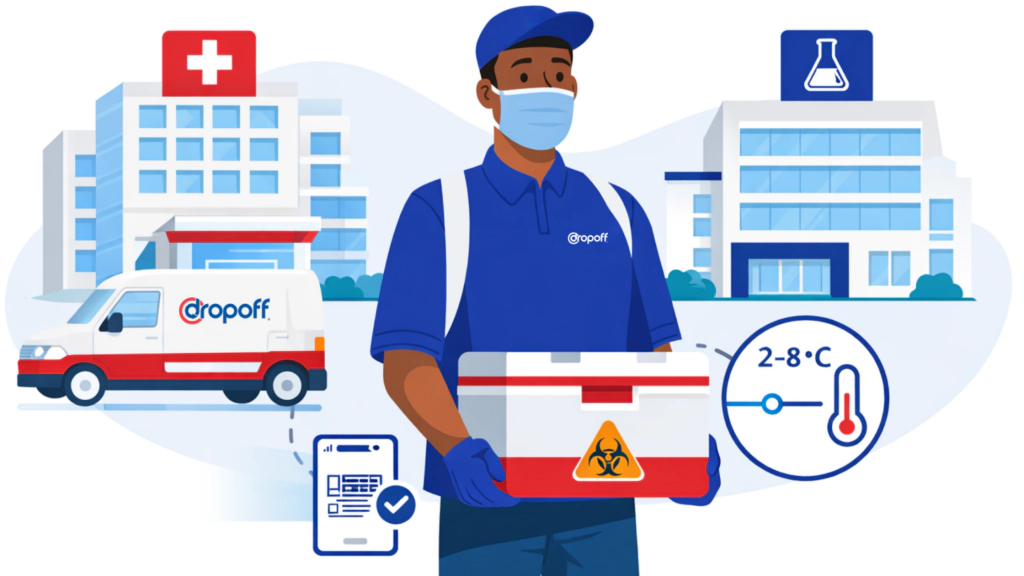
A delayed pickup.
A mislabeled tube.
A temperature excursion that goes unnoticed.
When biological samples move between clinics, hospitals, and laboratories, transport becomes part of the diagnostic process. A biological sample courier directly affects specimen integrity, turnaround time, compliance exposure, and patient outcomes.
A biological sample courier is a healthcare-focused delivery provider that transports diagnostic specimens under documented chain-of-custody and temperature-controlled conditions to protect test validity and regulatory compliance.
According to a 2025 peer-reviewed study in Clinical Chemistry and Laboratory Medicine, 98.4% of documented laboratory errors occurred in the pre-analytical phase, where transport, timing, and handling failures occur. Most lab errors happen before analysis begins.
Choosing the right courier for biological samples is not simply about speed. It is about documented chain-of-custody, temperature control, and operational reliability.
This guide compares biological sample courier services, explains cost drivers, and provides a practical checklist to evaluate a biological sample courier near you.
What Qualifies as a Biological Sample for Courier Transport?
A biological sample courier transports materials derived from humans, animals, or research organisms that require controlled handling, documented custody, or time-sensitive delivery.
Common categories include:
- Diagnostic specimens – blood, plasma, serum, tissue biopsies, swabs, urine, and pathology samples sent to clinical laboratories for testing
- Clinical trial materials – investigational samples, comparator materials, and research-related specimens tied to regulated study protocols
- Laboratory research samples – non-clinical biological materials used in academic or pharmaceutical research environments
- Temperature-sensitive materials – specimens requiring controlled ranges such as ambient, refrigerated (2–8°C), or frozen conditions
Many diagnostic specimens shipped domestically fall under UN3373 Category B, which applies to biological substances that do not meet Category A infectious substance criteria but still require specific packaging and labeling standards. A qualified courier for biological samples should understand these requirements at a practical level, including packaging integrity, documentation, and handling protocols.
For a more detailed overview of packaging standards and specimen handling requirements, see our guide to transporting blood and specimens.
The key distinction is not whether a sample is “medical,” but whether its integrity, timing, and traceability affect test accuracy or regulatory compliance. If transport conditions can alter results, the courier becomes part of the quality control process.
When Do You Need a Specialized Biological Sample Courier?
Not every shipment requires the same level of control. The need for a dedicated biological sample courier service depends on urgency, handling requirements, documentation standards, and risk exposure.
Below are the most common operational scenarios.
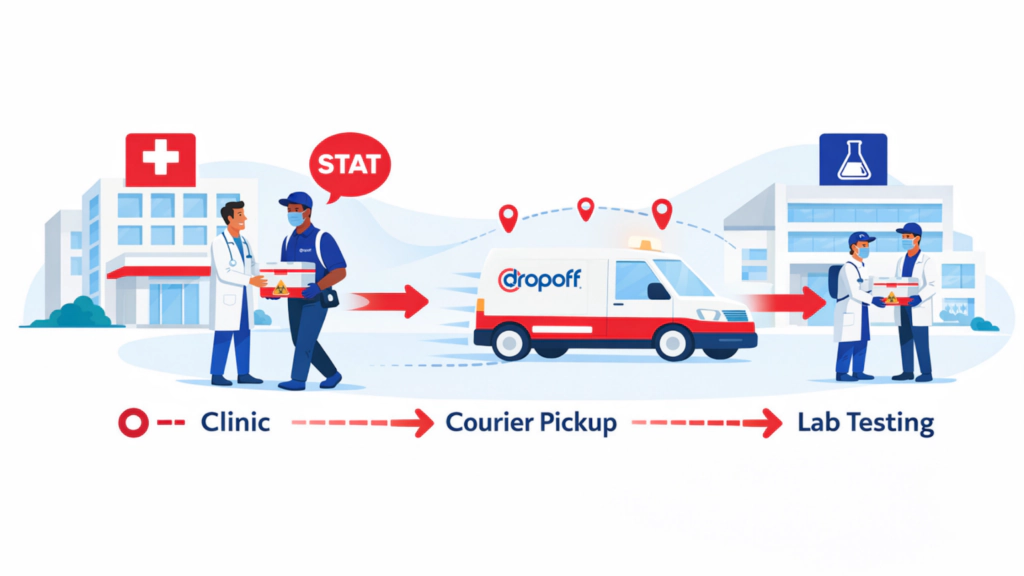
Same-Day STAT Specimens
Use a specialized courier for biological samples when:
- Results are time-critical
- Specimens have limited stability windows
- Patient care decisions depend on rapid turnaround
In these cases, delays are not operational inconveniences. They can affect diagnosis and treatment timelines. A same-day or STAT biological sample courier provides direct routing, real-time tracking, and documented handoff verification.
Parcel carriers are optimized for network efficiency. STAT medical deliveries require route control and immediate dispatch capability.
Scheduled Lab Routes (Clinic → Reference Lab)
Many healthcare networks operate recurring daily specimen transfers from clinics to centralized laboratories.
A dedicated biological sample courier is appropriate when:
- Predictable pickup windows are required
- Chain-of-custody must be documented consistently
- Volume justifies fixed-route optimization
- Temperature control needs to remain stable over multiple stops
Scheduled route programs reduce variability and create standardized handling workflows. This is difficult to replicate with ad hoc parcel shipping.
Hospital-to-Hospital Transfers
Inter-facility transfers may involve:
- Blood products
- Pathology slides
- Time-sensitive diagnostics
- Specialized testing not available onsite
These shipments often require direct delivery, recipient verification, and immediate confirmation. A courier for biological samples with trained drivers and digital proof-of-delivery reduces misrouting and custody ambiguity.
Clinical Trial Logistics
Clinical trial environments introduce additional complexity:
- Strict protocol adherence
- Documentation requirements
- Temperature validation
- Multi-site coordination
In these settings, biological sample courier services must align with study timelines and reporting standards. Visibility and exception reporting become critical.
International or Cross-Border Shipments
For cross-border biological sample transport:
- Customs documentation
- Regulatory classifications
- Packaging compliance
- Air transport coordination
Global integrators often have advantages for international lanes due to infrastructure and customs brokerage capabilities. However, local first-mile and last-mile custody may still require specialized medical couriers to ensure controlled handoff.
Biological Sample Courier Comparison: Choosing the Right Model
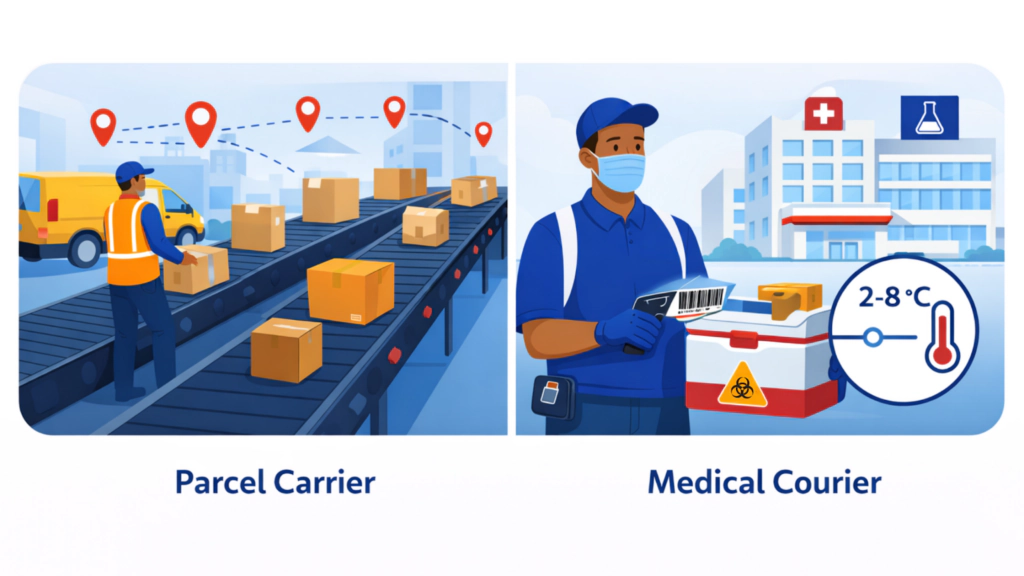
Parcel Carriers vs Dedicated Medical Couriers
| Factor | Parcel Carrier | Dedicated Biological Sample Courier |
| Routing Control | Network-optimized | Direct or controlled routes |
| Chain-of-Custody | Basic tracking | Documented handoffs |
| Temperature Oversight | Limited | Protocol-driven |
| STAT Capability | Limited | Immediate dispatch |
| Exception Handling | Centralized | Operationally responsive |
Parcel networks prioritize scale. Biological sample couriers prioritize control.
Local Last-Mile vs Global Integrators
- Local last-mile couriers excel at same-day delivery, fixed routes, and healthcare network integration.
- Global integrators provide cross-border infrastructure and air freight coordination.
The right model depends on shipment type, geography, and risk tolerance.
For organizations managing diagnostic specimens, clinical materials, or research samples, the question is not whether a courier can move a package. It is whether that biological sample courier service can preserve integrity, document custody, and support compliance at every handoff.
Top 5 Types of Biological Sample Courier Providers (And When to Use Each)
If you search for a biological sample courier, you’ll find dozens of companies claiming speed and reliability. The real decision is not which brand name ranks first. It is which provider model fits your operational risk profile.
Below are the five primary types of biological sample courier providers, when to use each, and where tradeoffs exist.
Provider Type 1: National Same-Day Medical Courier Networks
Best for: Urban and regional healthcare systems, hospital networks, diagnostic labs
Strengths:
- Same-day and STAT capability
- Real-time tracking and event scans
- Documented chain-of-custody
- Scheduled route programs
Limitations:
- Typically domestic focus
- Not built for complex international customs lanes
National same-day networks are often the strongest fit for recurring clinic-to-lab routes and urgent diagnostic transfers. These biological sample courier services prioritize route control and documented handoffs over parcel volume efficiency.
Provider Type 2: Global Integrators (Air Express)
Best for: Cross-border and international biological sample shipments
Strengths:
- Global air infrastructure
- Customs brokerage capability
- International regulatory familiarity
Limitations:
- Less control at the first-mile and last-mile level
- Limited flexibility for urgent local STAT pickups
Global integrators excel at international movement. However, for courier services for transporting biological samples within a metro or regional healthcare network, local custody control may matter more than international scale.
Provider Type 3: Specialty Life Sciences Couriers
Best for: Highly regulated clinical trial lanes and pharmaceutical logistics
Strengths:
- Packaging validation expertise
- Regulatory depth
- Temperature protocol documentation
Limitations:
- Higher cost structure
- Limited availability in some markets
These providers are purpose-built for complex life sciences workflows. They are often appropriate when validation requirements exceed routine clinical specimen transport.
Provider Type 4: Crowdsourced Delivery Platforms
Best for: Low-risk, non-sensitive items
Strengths:
- Broad driver networks
- On-demand availability
Limitations:
- Inconsistent training standards
- Limited chain-of-custody documentation
- Reduced compliance oversight
Crowdsourced models are optimized for consumer convenience, not controlled biological sample courier services. For diagnostic specimens or regulated materials, custody and documentation risks often outweigh cost savings.
Provider Type 5: Hybrid Regional Logistics Programs
Best for: Integrated healthcare networks with recurring route volume
Strengths:
- Route optimization
- Dedicated account management
- Healthcare-aligned SOPs
- Flexible STAT + scheduled mix
Limitations:
- Coverage typically regional rather than national
Hybrid regional programs combine the discipline of scheduled healthcare routes with same-day responsiveness. For many hospital and lab systems, this model balances speed, documentation, and cost efficiency.
Comparison: Biological Sample Courier Provider Models
| Provider Type | Best For | Speed | Chain-of-Custody | Temp Monitoring | Cost Level | Coverage |
| National Same-Day Medical Courier | Regional healthcare systems | High (STAT + scheduled) | Strong | Protocol-driven | Moderate | National / Metro |
| Global Integrator (Air Express) | Cross-border shipments | Moderate to High | Moderate | Available | Moderate–High | International |
| Specialty Life Sciences Courier | Clinical trials, pharma | High | Strong | Validated systems | High | Select Markets |
| Crowdsourced Platform | Low-risk items | Variable | Limited | Minimal | Low | Broad |
| Hybrid Regional Program | Integrated health systems | High | Strong | Protocol-driven | Moderate | Regional |
Choosing the right biological sample courier service depends on shipment type, urgency, compliance exposure, and geography. Scale alone does not guarantee control.
What to Look for in a Courier Service for Transporting Biological Samples
A reliable courier for biological samples should demonstrate operational controls that reduce error risk and protect specimen integrity. Below is a practical evaluation checklist.
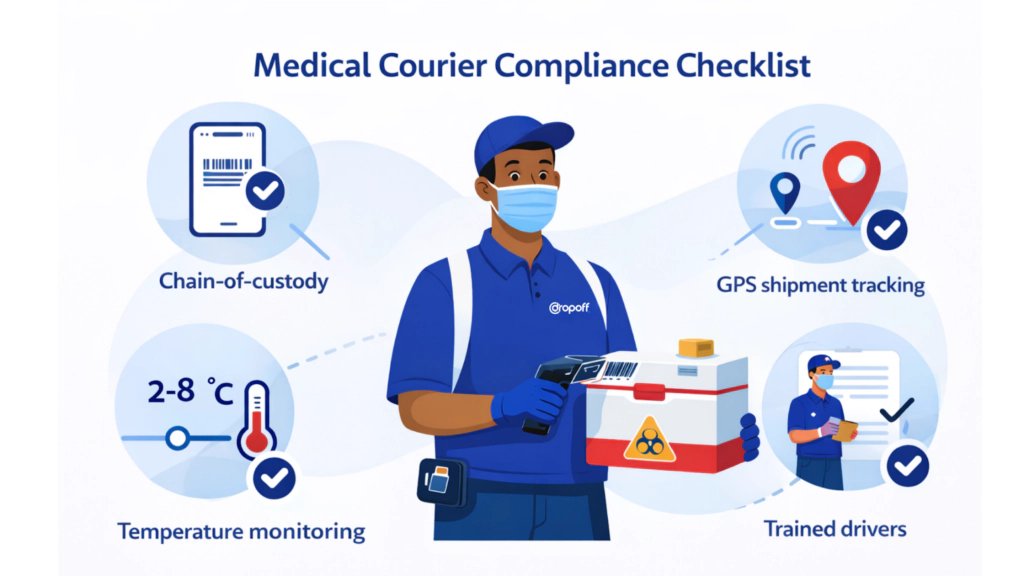
1. Chain-of-Custody Controls
Transport failures often occur before testing begins. According to an AHRQ analysis of mislabeled specimen errors, CAP data shows approximately 0.92 mislabeled specimen events per 1,000 cases.
Even small documentation gaps create measurable risk.
A biological sample courier should provide:
- Barcode scanning at pickup and delivery
- Time-stamped custody events
- Recipient verification
- Digital proof of delivery
Documented proof of delivery plays a critical role in audit readiness and dispute resolution. Our guide to proof of delivery and why it matters in healthcare logistics explains how digital confirmation reduces custody ambiguity and compliance risk.
Chain-of-custody is not a marketing term. It is an audit trail.
2. Temperature Management
Biological samples often require controlled temperature ranges. A 2023 study published in the Journal of the American Pharmacists Association found real-world temperature excursions during shipping across carriers and seasons, reinforcing the need for monitoring discipline.
Evaluate whether the courier service for transporting biological samples offers:
- Validated passive or active packaging options
- Monitoring devices when required
- Clear escalation protocols for temperature excursions
Temperature oversight should include defined thresholds and documented response steps.
3. Driver Training & Compliance Awareness
Drivers handling biological samples should understand:
- HIPAA-aware handling practices
- Specimen handling SOPs
- Documentation standards
- Escalation procedures
Our guide to staying HIPAA compliant when shipping with medical couriers outlines the safeguards organizations should expect from any courier transporting protected health information.
Training reduces variability at the most fragile handoff point.
4. Real-Time Visibility & Exception Handling
A qualified biological sample courier service should provide:
- GPS-based shipment tracking
- Automated delay alerts
- Backup driver protocols
- 24/7 operational support
Visibility alone is not sufficient. The question is how exceptions are resolved and documented.
5. Coverage & Redundancy
Local availability matters when searching for a biological sample courier near me, but geographic presence alone is not enough.
Ask about:
- Route density
- Dispatch service level agreements
- After-hours availability
- Backup capacity during volume spikes
Reliable coverage reduces disruption during peak periods or unexpected demand.
Most competitors list features. The differentiator is execution. A biological sample courier service should demonstrate how custody, temperature control, and documentation are embedded into daily operations, not treated as optional add-ons.
Biological Sample Courier Costs in 2026
The cost of biological specimen transport depends less on the label “medical” and more on operational variables. Healthcare leaders evaluating courier services for transporting biological samples should focus on the drivers below.
Distance & Route Density
Short-distance deliveries within a dense metro area are typically more cost-efficient than long rural routes. Route density matters. Scheduled lab routes that consolidate multiple pickups often lower per-stop costs compared to isolated, one-off deliveries.
Regional same-day biological sample courier services generally fall into moderate cost tiers, while longer-haul or low-density routes trend higher due to mileage and driver time.
STAT vs Scheduled Delivery
Urgency increases cost.
- STAT deliveries require immediate dispatch, direct routing, and minimal batching.
- Scheduled routes allow optimization and predictable planning.
Organizations with recurring clinic-to-lab workflows often reduce courier costs by blending STAT capability with structured daily routes.
Temperature Control Requirements
Temperature-sensitive biological samples introduce additional cost variables:
- Validated insulated packaging
- Active cooling solutions
- Monitoring devices
- Escalation procedures for excursions
The greater the temperature control requirement, the higher the handling complexity. A 2023 study published in the Journal of the American Pharmacists Association documented real-world temperature excursions during shipment, reinforcing why monitoring standards influence both risk and cost.
After-Hours or Weekend Service
Healthcare does not operate on a standard business calendar. Courier services for biological samples that provide:
- Evening pickups
- Weekend delivery
- Holiday coverage
- 24/7 dispatch
typically carry incremental service premiums due to staffing and operational readiness.
Packaging & Monitoring
Some biological sample courier services include packaging guidance and tracking devices as part of their offering. Others require client-supplied materials.
Monitoring tools, data logging, and validated packaging increase per-shipment cost but reduce specimen rejection risk.
While pricing varies by geography and service level, healthcare organizations should expect biological sample courier services to reflect the operational controls required to protect specimen integrity and compliance.
“Biological Sample Courier Near Me”: How to Evaluate Local Providers
Searching for a biological sample courier near me is common. Proximity matters. But geography alone does not guarantee reliability.
A biological sample courier near you should demonstrate measurable performance standards, not just geographic proximity.
Why Proximity Alone Isn’t Enough
A courier located nearby may still lack:
- Healthcare-specific handling protocols
- Redundant driver capacity
- Real-time visibility tools
- Defined escalation processes
A biological sample courier must demonstrate process discipline, not just physical presence.
How to Verify Reliability
Ask for performance metrics, not marketing claims. Reliable courier services for transporting biological samples should provide:
- Historical on-time delivery rates
- Incident reporting standards
- Documentation samples
- Service level agreements (SLAs)
Request proof of operational consistency.
Questions to Ask About Backup Capacity
Healthcare transport cannot pause during driver illness, vehicle issues, or volume spikes. Evaluate whether the courier has:
- Backup drivers
- Redundant routing capability
- After-hours dispatch
- Escalation protocols
Coverage redundancy protects patient care timelines.
Proof-of-Performance Metrics to Request
When evaluating a biological sample courier service, ask:
- What is your average on-time rate?
- How are exceptions documented and communicated?
- What happens if a specimen is rejected due to transport issues?
- Do you provide digital custody logs with time stamps and recipient verification?
Competitors often avoid publishing measurable performance data. Healthcare supply chain leaders should not.
The Hidden Risk: Why Transport Drives Most Lab Errors
Transport is frequently treated as a logistics task. In reality, it is part of the diagnostic workflow.
Peer-reviewed research consistently shows that most laboratory errors occur in the pre-analytical phase — before analysis begins — where specimen handling, labeling, timing, and transport variability introduce risk.
Pre-analytical risk includes:
- Delayed delivery beyond stability windows
- Hemolysis due to improper handling
- Temperature excursions
- Mislabeling during handoff
- Incomplete documentation
Even small deviations can alter test validity or require specimen recollection.
For example, a delayed delivery beyond a specimen’s stability window may require recollection, extending diagnosis timelines and increasing patient inconvenience.
Transport timing influences analyte stability. Labeling accuracy affects traceability. Documentation gaps create compliance exposure.
A biological sample courier service that embeds custody controls, standardized scanning, and escalation protocols reduces variability in the most error-prone phase of laboratory testing.
Operational accountability does not end at the lab door. It begins at pickup.
How Dropoff Supports Biological Sample Delivery Workflows
Dropoff supports hospitals, laboratories, pharmacies, and healthcare networks with structured biological sample courier programs built around custody control, real-time visibility, and disciplined route execution. Our healthcare delivery programs are designed specifically for regulated environments where specimen integrity and documentation standards matter.
Dropoff supports more than 270 national brands across regulated industries, including healthcare and life sciences.
For laboratory environments with recurring clinic-to-lab transfers or STAT diagnostic needs, our lab-focused delivery workflows provide route consistency, documented handoffs, and escalation support built for healthcare operations.
If you’re evaluating biological sample courier services and need a structured program rather than ad hoc transport, you can request a quote to assess fit within your network.
Reliable transport protects specimen integrity. Controlled workflows protect your organization.
Frequently Asked Questions About Biological Sample Courier Services
A biological sample courier is a specialized delivery provider that transports blood, diagnostic specimens, clinical trial materials, and other regulated biological substances under controlled conditions. These courier services prioritize chain-of-custody documentation, temperature stability, and time-sensitive delivery to protect specimen integrity.
Biological samples can be delivered the same day, via STAT service, on scheduled lab routes, or overnight depending on urgency and distance. A dedicated biological sample courier typically offers faster dispatch and more direct routing than standard parcel networks.
Yes. Many biological samples are shipped overnight for intercity or cross-border transfers. However, overnight parcel shipping may not provide the same documented custody controls or real-time visibility as a dedicated biological sample courier service.
Temperature-sensitive biological samples are transported using validated packaging, insulated containers, and, when required, temperature monitoring devices. A qualified courier for biological samples defines acceptable temperature ranges and documents any excursion with a clear escalation process.
Yes. Professional medical couriers provide digital proof of delivery that includes time stamps, recipient verification, and documented custody transfer. These controls reduce labeling errors and strengthen audit readiness in healthcare logistics.
Biological sample courier costs vary based on distance, urgency, temperature requirements, service hours, and route density. Scheduled routes typically cost less per stop than STAT deliveries. Healthcare organizations should evaluate cost alongside reliability, custody controls, and compliance standards.
Checklist: Choosing the Right Biological Sample Courier
Selecting a biological sample courier is an operational risk decision. Use this checklist to evaluate courier services for transporting biological samples.
Coverage
Does the biological sample courier operate consistently in your service area?
Is backup capacity available during volume spikes or driver absence?
Custody Controls
Are barcode scans and time stamps captured at every handoff?
Is digital proof of delivery included with recipient verification?
Temperature Management
Are packaging standards validated for required temperature ranges?
Are monitoring tools available when risk warrants them?
Compliance Awareness
Are drivers trained in healthcare handling protocols?
Are documentation standards structured for audit readiness?
Visibility
Is real-time tracking available throughout transport?
Are delays and exceptions proactively communicated?
Support Model
Is 24/7 dispatch available?
Are escalation procedures clearly defined and documented?
Cost Transparency
Are pricing drivers clearly explained?
Are service levels tied to measurable performance?
When specimen integrity directly affects diagnostic accuracy, transport cannot be an afterthought. Request a quote for biological sample delivery in your area.