Building a Retail Delivery Fleet That Wins in 2026
Retail delivery has entered a more disciplined phase. As delivery costs rise and consumer tolerance for delays increases, the retailers that win are those that design fleets for reliability, not just speed.
By 2026, the question for most operators is no longer whether a retail delivery fleet is strategically important. The real question is whether the fleet they’ve built can consistently meet delivery SLAs, absorb demand volatility, and control cost as last-mile delivery becomes a core part of the retail value proposition.
Speed still matters.
But in practice, reliability, delivery visibility, and operational control matter more.
Retailers that perform well treat fleet operations as a system, not a set of vehicles. They design for delivery density, define service levels clearly, invest in delivery and fleet management infrastructure, and plan for capacity flexibility when volume spikes or conditions change.
This guide breaks down what a winning retail delivery fleet looks like in 2026 and how supply-chain leaders can design one that performs under real operational pressure, not ideal conditions.
What a Retail Delivery Fleet Is (and What It Isn’t)
A retail delivery fleet is the coordinated set of vehicles, drivers, operating processes, and technology used to execute last-mile delivery from stores, hubs, or fulfillment locations to customers or downstream destinations.
In practice, this includes owned or leased vehicles, trained drivers, defined routes, and delivery orchestration systems that manage dispatch, tracking, exception handling, and proof of delivery. For many retailers, it also includes supplemental delivery capacity used to protect service levels during seasonal peaks, promotions, weather events, or network disruptions.
What a retail delivery fleet is not is a guaranteed path to lower costs or automatic operational control.
Fleets underperform when they are built on assumptions rather than operating data. Adding vehicles without sufficient stop density increases last-mile delivery costs and drives up cost per delivery. Hiring drivers without standardized workflows introduces inconsistency. Expanding geographic coverage before routes stabilize creates service risk that compounds quickly at scale.
Most modern retail delivery fleets fall into three structural models: store-based delivery, hub-and-spoke networks, and hybrid fleets. The most resilient retailers intentionally choose hybrid models, combining predictable core routes with flexible last-mile capacity to maintain reliability under real operating conditions.
Why 2026 Changes the Math for Retail Delivery
Structural shifts are reshaping how retailers approach last-mile delivery.
Private and alternative delivery networks continue to grow. According to the ShipMatrix 2024 Parcel Shipping Intelligence Report, “other carriers,” including private retail fleets and regional providers, delivered 2.3 billion packages in 2024, a 44% year-over-year increase from 2023.
Consumer expectations have also matured. A 2024 McKinsey analysis found that most U.S. consumers are willing to wait multiple days for e-commerce delivery when transparency and cost expectations are clearly met. Reliability and communication increasingly outweigh raw speed.
At the same time, operating constraints are tightening. A 2025 World Economic Forum report highlights growing urban congestion, emissions regulations, and access restrictions as increasing operational complexity and cost pressure for last-mile delivery networks.
Together, these forces mean retail delivery fleets must be designed for predictability, not just speed.
The Core Variables That Determine Fleet Performance
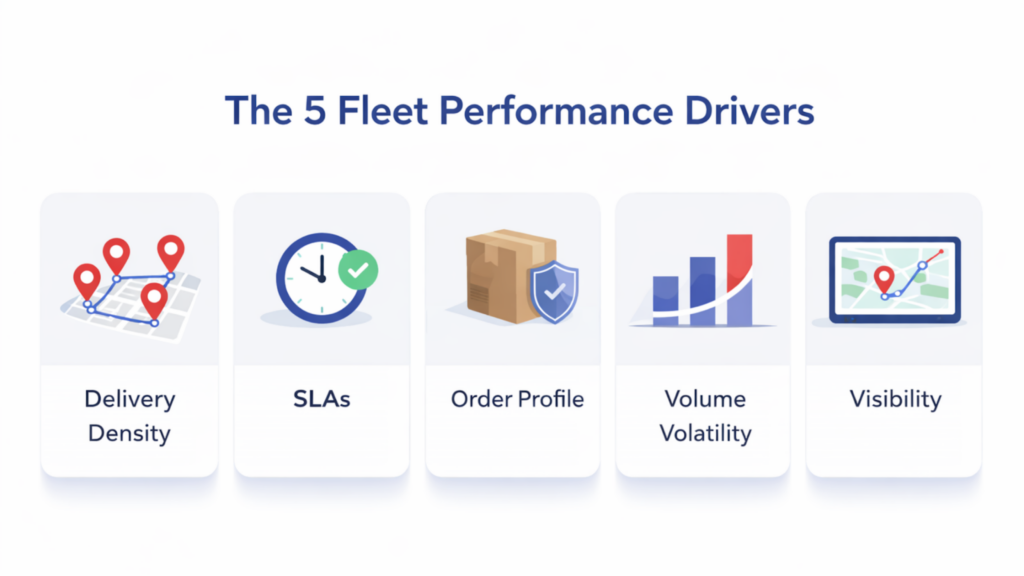
Every high-performing retail delivery fleet is governed by the same underlying operational variables. These factors determine whether last-mile delivery scales predictably or breaks under pressure, regardless of fleet size or market coverage.
Common Reasons Retail Delivery Fleets Underperform
Most retail delivery fleet failures are not caused by lack of effort or technology. They stem from structural decisions made too early.
A common failure pattern is expanding delivery coverage before achieving sufficient stop density. This increases miles per stop, inflates labor costs, and reduces on-time performance.
Another issue is underestimating exception handling. Fleets built around ideal delivery conditions struggle when weather, access issues, or customer availability disrupt routes.
Finally, many retailers measure delivery performance too narrowly. Tracking only on-time delivery masks first-attempt failures, driver variability, and unresolved exceptions that degrade customer trust over time.
High-performing fleets address these risks through conservative expansion, disciplined SLA definitions, and visibility into real operating conditions.
Delivery Density and Route Predictability
Delivery density is the single most important driver of fleet efficiency.
Routes with clustered stops, consistent order volume, and stable delivery patterns reduce miles per stop, lower driver idle time, and decrease exception rates. Higher density improves vehicle utilization and allows fleets to complete more deliveries per route without extending delivery windows or labor hours.
Retailers often run into trouble when they expand delivery geography before achieving sufficient density. As routes stretch farther apart, costs rise faster than revenue, and service levels become harder to maintain. Winning retail delivery fleets prioritize depth within defined delivery zones before expanding outward into new markets.
Order Profiles and Delivery Windows
Not all retail deliveries create the same operational burden.
High-value items, groceries, regulated products, and time-sensitive orders carry higher failure costs and tighter delivery constraints. Narrow delivery windows reduce routing flexibility and increase reliance on precise dispatch, real-time communication, and fast exception handling when delays occur.
Retailers that segment delivery service levels by order profile are better positioned to balance cost and reliability. Aligning delivery windows, routing logic, and driver instructions to the risk profile of each order type improves fleet performance without overengineering the entire last-mile operation.
Service Level Agreements (SLAs)
Delivery SLAs only improve outcomes when they are actively managed.
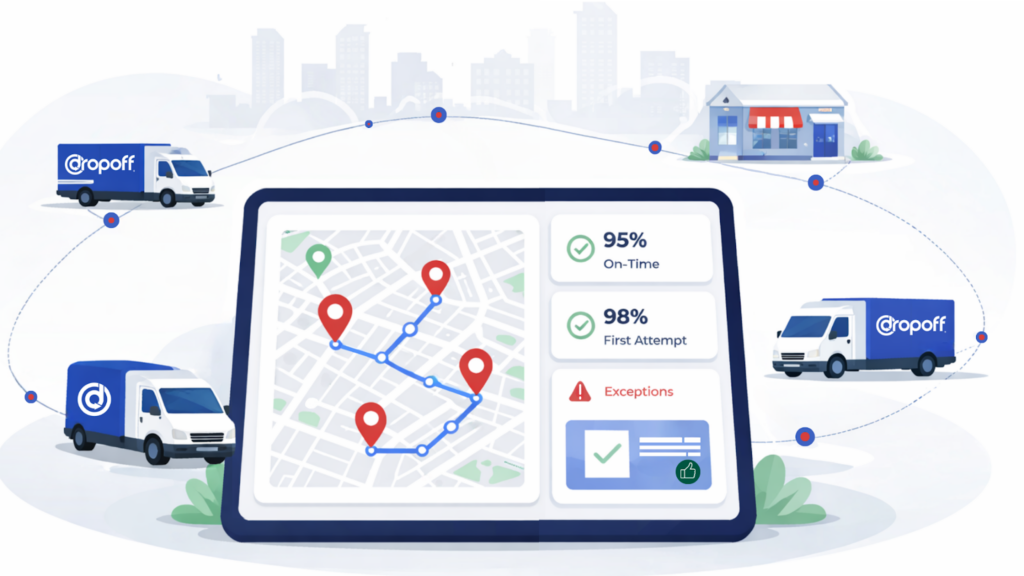
On-time delivery percentages alone rarely tell the full story. High-performing fleets track first-attempt delivery success, exception resolution time, and proof-of-delivery completion to understand where breakdowns occur. These metrics surface operational issues early, before missed deliveries turn into customer complaints or chargebacks.
When SLAs are treated as reporting artifacts instead of operational controls, teams react too late. Effective SLA governance allows retail delivery fleets to intervene while problems are still recoverable.
Volume Volatility and Seasonality
Retail demand is inherently uneven.
Promotions, holidays, weather events, and regional campaigns create sharp delivery spikes that rigid fleets struggle to absorb. Excess capacity during slow periods inflates fleet management costs, while insufficient capacity during peaks erodes trust and service reliability.
Retailers that design for variability use hybrid capacity models to balance baseline routes with flexible last-mile delivery support. This approach protects delivery SLAs without forcing the organization to carry year-round capacity sized for peak demand.
Visibility and Proof of Delivery
Real-time delivery visibility is an operational requirement, not a feature.
Without accurate tracking and verifiable proof of delivery, retail teams spend time resolving disputes, managing escalations, and reconciling incomplete delivery data. These manual interventions add hidden cost and slow decision-making as volume increases.
“An idle operating room costs $30–$100 per minute. If a critical implant or instrument doesn’t arrive on time, it’s not just a delay. It’s thousands in wasted overhead, lost productivity, and a patient left waiting. Same-day delivery in healthcare isn’t about convenience. It’s about protecting the economics of care.Reliability isn’t an expense. It’s the cheapest form of insurance a hospital has.”
— Sean Spector, Co-Founder & CEO, Dropoff
End-to-end visibility allows fleet managers to monitor performance in real time, identify emerging issues, and confirm delivery outcomes across in-house and outsourced capacity. As retail delivery fleets scale, visibility becomes essential to maintaining control rather than relying on assumptions.
The Retail Delivery Fleet Operating System in 2026
Winning retail delivery fleets no longer rely on informal processes or manual coordination. In 2026, performance depends on a clearly defined delivery operating system that integrates network design, capacity planning, driver standards, and delivery technology into a single, repeatable model.
Retailers that treat fleet operations as a system gain consistency and cost control. Those that don’t are forced into reactive decision-making as volume, geography, and service expectations expand.
Network Design
Fleet performance starts with where deliveries originate and how the network is structured.
Some retailers fulfill last-mile delivery directly from stores. Others rely on micro-fulfillment hubs, dark stores, or regional facilities designed to support higher delivery density. The most effective network designs minimize handoffs, shorten delivery radii, and align delivery capacity with actual order demand rather than historical store footprints.
Poor network design increases route length, adds complexity, and drives higher last-mile delivery costs. High-performing retail delivery fleets regularly reassess network design as order volume, customer locations, and fulfillment strategies change. Static networks rarely hold up as delivery demand evolves.
Capacity Planning
Capacity planning determines whether a retail delivery fleet remains stable under pressure or breaks during peak demand.
High-performing fleets separate predictable baseline routes from flexible overflow capacity. Baseline routes are built around consistent volume and repeat delivery patterns. Overflow capacity absorbs promotions, seasonal spikes, weather disruptions, and unexpected demand shifts without compromising delivery SLAs.
Retailers that size fleets only for average demand struggle during peaks. Those that size for peak demand carry excess fleet management costs year-round. A disciplined capacity planning model allows retailers to balance utilization, labor efficiency, and service reliability as delivery volume fluctuates.
Driver Standards and Training
Drivers are both operational assets and the most visible extension of the retail brand.
Clear onboarding requirements, documented standard operating procedures, and consistent performance scorecards reduce variability across routes and regions. These controls directly affect first-attempt delivery success, dwell time, and proof-of-delivery accuracy.
In retail and healthcare delivery environments, where service failures carry higher risk, driver standards are especially critical. Fleets that invest in training and measurement see fewer exceptions, faster issue resolution, and more consistent customer experiences as delivery volume grows.
Retail Delivery Management Software
Retail delivery management software is the coordination layer that enables the operating system to function at scale.
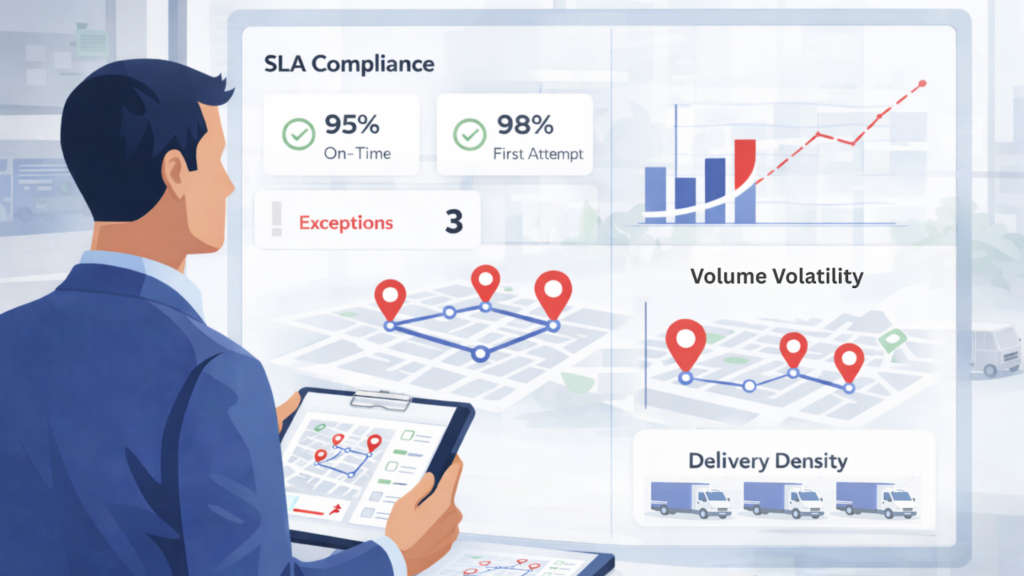
It connects dispatch, route optimization, real-time tracking, exception management, proof of delivery, and customer communication into a unified workflow. This visibility allows fleet managers to monitor performance, enforce delivery SLAs, and intervene before minor issues become service failures.
Without a delivery management platform, teams rely on manual updates, spreadsheets, and reactive troubleshooting. That approach becomes increasingly expensive and unreliable as last-mile delivery operations scale. In 2026, retail delivery fleets that lack orchestration technology struggle to maintain control as complexity increases.
Retail Delivery Fleet SLA Governance
SLAs function as operating controls, not contractual language.
Retailers should distinguish between customer-facing SLAs, such as delivery windows, and internal operational SLAs, such as response time to exceptions. Weekly trend analysis and daily monitoring allow teams to intervene before service degradation becomes visible.
Delivery SLA management systems exist because manual oversight breaks under complexity.
Lessons from Online Grocery and Regulated Delivery
Online grocery offers a useful reference point.
Grocers operate with narrow delivery windows, perishable inventory, and low tolerance for failure. They emphasize route discipline, proactive customer communication, and rapid exception resolution.
These same principles apply to healthcare delivery, enterprise logistics, and high-value retail fulfillment, where chain-of-custody and service consistency matter as much as speed.
Build, Outsource, or Hybrid: Making the Right Call
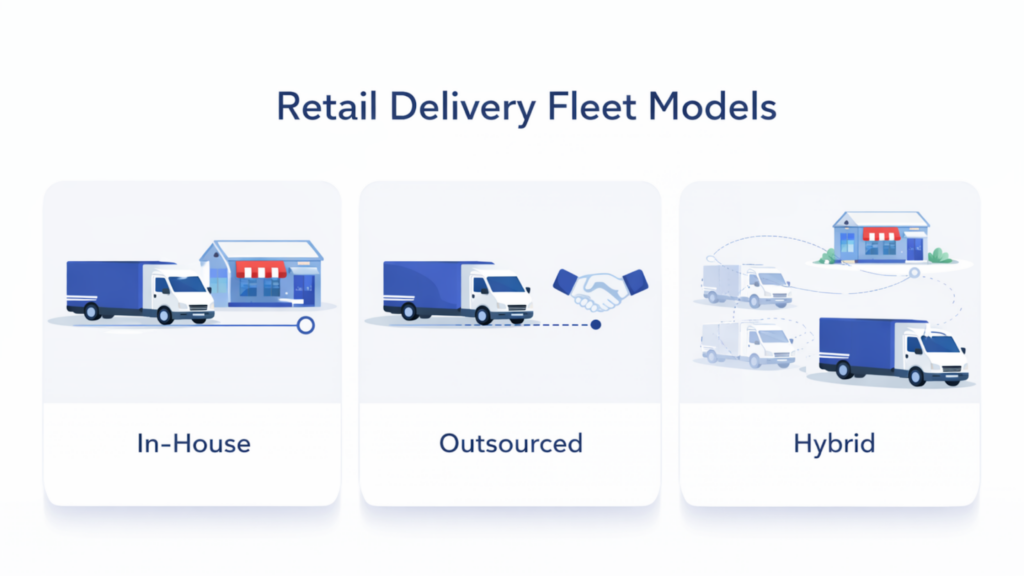
No single delivery model fits every retailer.
In-house fleets perform best when volume is dense and predictable. Outsourced delivery provides geographic reach and variable capacity. Hybrid models dominate in practice, allowing retailers to retain control where it matters while supplementing capacity during peaks or expansion.
How Retailers Should Decide Which Delivery Fleet Model to Use
Choosing the right retail delivery fleet model requires aligning delivery economics with demand behavior.
Retailers with dense, predictable order volume often benefit from operating in-house delivery fleets for core routes, where utilization stays high and service levels are easier to control. However, fixed fleets become expensive when demand fluctuates across seasons, regions, or channels.
Outsourced last-mile delivery works best for geographic expansion, low-density markets, or variable demand, but it can introduce visibility gaps and inconsistent service if not tightly governed.
For most large retailers, a hybrid delivery fleet model performs best. Core routes remain in-house or dedicated, while flexible capacity is layered in during peak periods, promotions, or weather disruptions. This approach preserves control where it matters while reducing the risk of overbuilding permanent fleet capacity.
The strongest operators evaluate fleet models using delivery density, demand volatility, failure cost, and SLA risk, not ideology.
What the Retail Delivery Manager Owns in 2026
The retail delivery manager’s role has expanded.
Today, it includes SLA performance, delivery technology oversight, capacity planning, vendor governance, and exception escalation. Success depends on system design rather than constant firefighting.
The strongest operators improve inputs so outputs stabilize.
Designing a Retail Delivery Fleet That Holds Up
A winning retail delivery fleet in 2026 is not defined by speed or size.
It is defined by density over distance, SLAs over promises, visibility over assumptions, and hybrid capacity over rigid ideology.
Retailers looking to strengthen delivery performance should focus on operating fundamentals, not expansion alone. Improving last-mile delivery efficiency and controlling fleet management costs starts with system design.
The retailers that win are not the ones who try to do everything themselves. They are the ones who build delivery fleets that perform under pressure.
Retail Delivery Fleet FAQs: Strategy, Costs, and Operations
A retail delivery fleet is the combination of vehicles, drivers, routing processes, and technology used to complete last-mile delivery from stores, distribution centers, or micro-fulfillment locations to customers. In practice, it includes fleet management policies, delivery capacity planning, dispatch workflows, and delivery SLAs that determine reliability, cost control, and customer experience at scale.
Retailers should build, outsource, or hybridize based on volume stability, geographic density, and service-level risk. In-house fleets offer control at steady volumes, outsourced fleets add flexibility, and hybrid delivery models balance baseline routes with overflow capacity. Most operational failures occur when retailers overbuild fixed capacity for demand that fluctuates by season, channel, or location.
The biggest cost drivers are labor, vehicle utilization, failed delivery attempts, and route inefficiency. Fleet management costs rise quickly when delivery density drops or when time windows are too tight. Technology gaps also increase cost by forcing manual dispatch, slower exception handling, and poor visibility into last-mile delivery performance.
Retailers scale delivery capacity by combining planned routes with flexible last-mile delivery partners. Fixed fleets struggle during promotions, holidays, and weather disruptions because vehicle and driver availability cannot expand quickly. Hybrid delivery models reduce risk by maintaining core routes while adding short-term capacity without permanently increasing fleet management costs.
Effective retail delivery fleet management requires real-time tracking, dynamic routing, proof of delivery, and exception management tools. Without visibility into delivery status and driver performance, retailers struggle to enforce delivery SLAs or respond to service failures. Technology is especially critical for coordinating last-mile delivery across multiple locations and service levels.
Delivery SLAs are defined by on-time performance, first-attempt success rates, and issue resolution time. Enforcing delivery SLAs requires consistent measurement across in-house and outsourced fleets. Retailers that lack unified reporting often miss early warning signs, leading to customer complaints, chargebacks, or lost revenue tied to unreliable last-mile delivery execution.
A hybrid delivery model makes sense when retailers need predictable service for core routes and flexibility for spikes, new markets, or same-day orders. It reduces risk by aligning delivery capacity with demand instead of forcing fleet expansion. Hybrid models are especially effective when service reliability and cost control matter more than owning every delivery asset.